Introduction
How to choose bathroom mirror size can seem confusing when you have different vanity widths, sink layouts, wall spaces, and mirror shapes to consider. The right mirror should complement your vanity without looking too small or overwhelming the bathroom. In this guide, you’ll learn how to measure your space, choose the right mirror width and height, and select a size that creates a balanced and functional bathroom.
Table of Contents
How to Choose Bathroom Mirror Size
Knowing how to choose bathroom mirror size starts with more than simply picking a mirror that looks attractive. The right size should work with your vanity, sink configuration, available wall space, and other bathroom fixtures. A well-sized mirror creates better visual balance while providing enough surface area for everyday use.
Start With Your Bathroom Vanity Width
The vanity is usually the best starting point when deciding on mirror dimensions. Begin by measuring the full width of your bathroom vanity from one outside edge to the other. This measurement gives you a useful reference for determining how wide your mirror should be.
In most bathrooms, the mirror should be the same width as the vanity or slightly narrower. For example, if your vanity is 36 inches wide, a mirror around 30 to 36 inches wide will generally create a balanced appearance.
A mirror that extends significantly beyond the vanity can make the space look disproportionate, particularly when the surrounding wall is narrow. Choosing a mirror that fits within the vanity’s width also leaves room for other elements, such as wall lights or decorative features.
However, there is no universal rule that requires the mirror to be exactly the same width as the vanity. The overall wall layout, mirror shape, lighting, and bathroom style should also influence your final choice.
Consider the Number of Sinks
The number of sinks is another important factor when learning how to choose bathroom mirror size. A single-sink vanity and a double-sink vanity can require very different mirror arrangements.
For a single-sink vanity, one appropriately sized mirror centered above the sink is usually the simplest option. The mirror can be rectangular, round, oval, or another shape as long as its proportions work with the vanity.
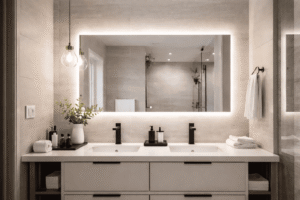
For a double-sink vanity, you generally have two main choices: use one large mirror that covers both sinks or install two individual mirrors, with one positioned above each sink.
One large mirror can create a clean, unified appearance and may make the wall feel more spacious. Two separate mirrors can provide a more symmetrical look and work especially well when each sink has its own wall-mounted light.
When choosing between these options, consider the width of the vanity, the distance between the sinks, the available wall space, and the location of lighting fixtures. The mirror arrangement should complement the entire vanity rather than focusing only on the sinks.
Measure the Available Wall Space
Before purchasing a mirror, measure the wall where you plan to install it. Vanity width alone does not tell you the maximum practical mirror size. Cabinets, walls, windows, lighting fixtures, shelves, and other bathroom elements can limit the available space.
Measure the usable horizontal and vertical area around the vanity. If wall sconces will be installed beside the mirror, leave enough room for them without making the mirror feel crowded.
You should also consider the position of the faucet, backsplash, medicine cabinet, shelves, and nearby cabinets. These elements can affect both the mirror’s dimensions and its final placement.
Finally, leave some visual breathing room around the mirror. A mirror that fills every available inch of wall can make the bathroom feel cramped, while one that is too small may look disconnected from the vanity.
The best approach is to balance vanity width, sink configuration, wall space, and surrounding fixtures. Taking these measurements before shopping makes it much easier to choose a bathroom mirror that looks proportional and functions comfortably.
Should a Bathroom Mirror Be Wider Than the Vanity?
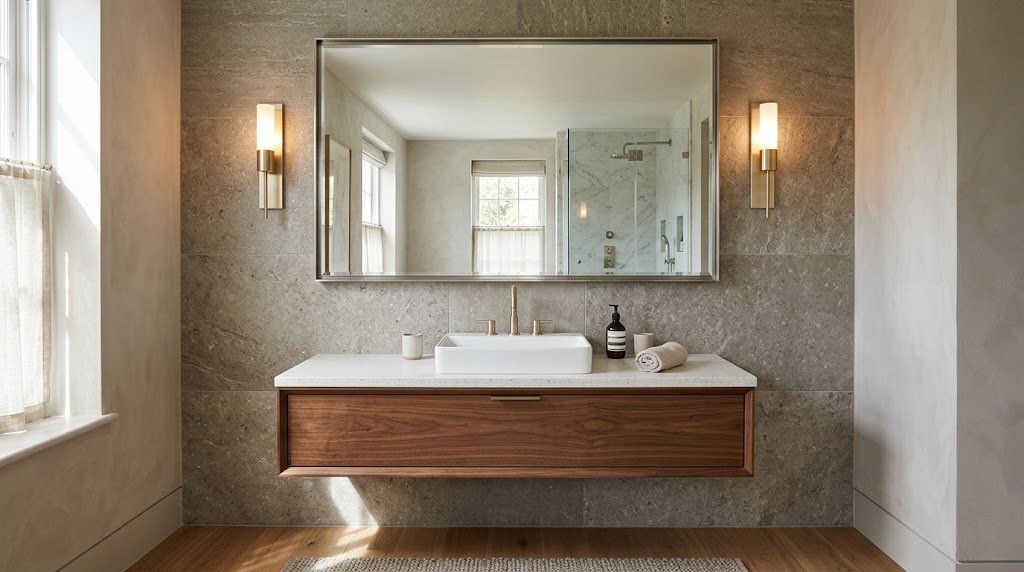
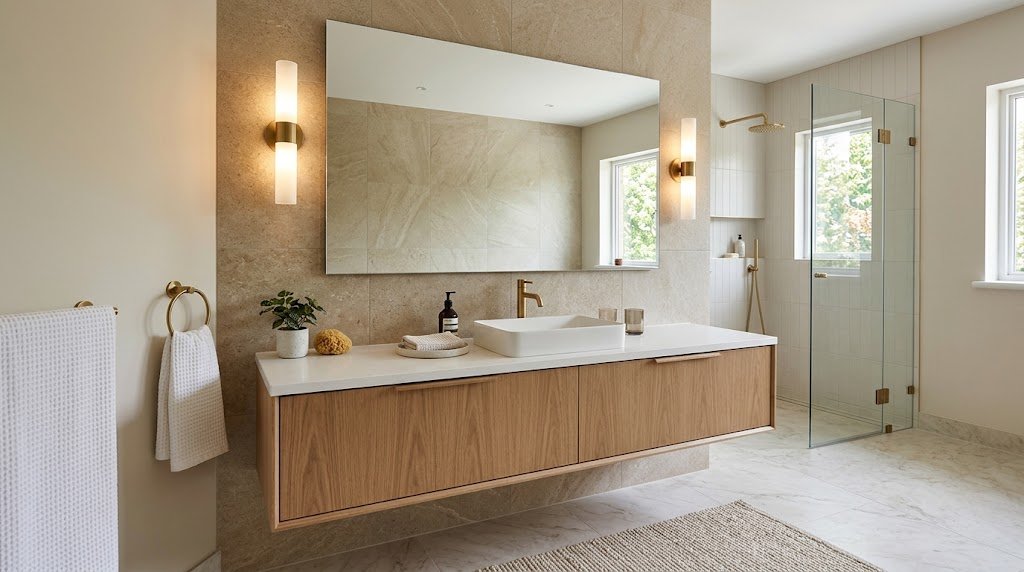
When learning how to choose bathroom mirror size, one of the most common questions is whether the mirror should be wider than the vanity. In most cases, a bathroom mirror should not be wider than the vanity. A mirror that is slightly narrower than the vanity usually creates a more balanced and intentional appearance.
General Sizing Rule
A simple rule is to choose a mirror that is the same width as the vanity or slightly narrower. The mirror does not need to match the vanity exactly, but it should generally fit within its overall width.
For example, if you have a 36-inch vanity, a mirror between approximately 30 and 36 inches wide can provide a proportional look. This approach also leaves some space on either side for lighting, accessories, or visual separation.
The exact size can vary depending on the shape of the mirror and the layout of your bathroom.
Recommended Mirror-to-Vanity Proportions
For a traditional vanity setup, a mirror that is about 70% to 100% of the vanity’s width is a useful starting point. This range gives you flexibility while helping maintain visual balance.
For example:
| Vanity Width | Approximate Mirror Width |
|---|---|
| 24 inches | 18–24 inches |
| 30 inches | 21–30 inches |
| 36 inches | 25–36 inches |
| 48 inches | 34–48 inches |
| 60 inches | 42–60 inches |
| 72 inches | 50–72 inches |
These measurements are guidelines rather than strict requirements. Your wall dimensions, mirror shape, lighting, and personal preferences should also be considered.
When a Slightly Narrower Mirror Works Better
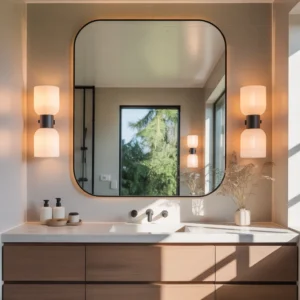
A slightly narrower mirror can be a better choice when you want to install wall sconces beside it. The additional space provides room for lighting without making the wall look crowded.
A narrower mirror can also work well when the vanity has decorative sides, large countertops, or other features that you want to keep visually prominent. In a small bathroom, leaving a little wall space around the mirror can make the area feel less cramped.
Round and oval mirrors often benefit from being somewhat narrower than the vanity because their curved edges naturally create additional visual space around the fixture.
When a Wider Mirror May Be Appropriate
Although the general recommendation is to keep the mirror within the vanity’s width, there are situations where a wider mirror can work. For example, a large frameless mirror may extend beyond a vanity when the wall has plenty of open space and there are no nearby cabinets or fixtures creating visual conflicts.
A wider mirror can also be practical when it is intended to reflect more light or visually expand a larger bathroom. However, it should not extend so far that it interferes with wall lights, cabinets, doors, or other fixtures.
Ultimately, how to choose bathroom mirror size depends on the complete layout rather than one fixed measurement. Start with the vanity width, then consider the available wall space, mirror shape, lighting, and surrounding fixtures before making your final decision.
What Size Mirror Should You Choose for Different Vanity Widths?
When figuring out how to choose bathroom mirror size, your vanity width is one of the easiest measurements to use as a starting point. In most cases, the mirror should be slightly narrower than the vanity or close to the same width.
The table below provides practical mirror-width ranges for common bathroom vanity sizes:
| Vanity Width | Suggested Mirror Width |
|---|---|
| 24 inches | 20–24 inches |
| 30 inches | 24–30 inches |
| 36 inches | 30–36 inches |
| 48 inches | 42–48 inches |
| 60 inches | 54–60 inches |
| 72 inches | 60–72 inches |
These measurements are practical starting points, not rigid rules. The ideal mirror size can change depending on your bathroom layout, mirror shape, wall space, lighting, and the position of other fixtures.
For example, a 36-inch vanity could work well with a 30-inch rectangular mirror if you want space for sconces on either side. On the other hand, a 36-inch frameless mirror that is nearly the same width as the vanity can create a clean, continuous appearance.
For larger vanities, consider whether you want one wide mirror or multiple mirrors. A 60-inch or 72-inch double vanity may look balanced with one large mirror, while two separate mirrors can provide better symmetry when each sink has its own lighting.
Before buying, measure both the vanity and available wall space. Also account for cabinets, windows, sconces, shelves, and other fixtures. These measurements will help you apply the sizing guidelines to your specific bathroom rather than relying on a standard size alone.
Bathroom Mirror Size for a Single Sink Vanity
A single-sink vanity gives you more flexibility when choosing a bathroom mirror because you only need to accommodate one sink and faucet. When considering how to choose bathroom mirror size, focus on the vanity width, sink position, available wall space, and the overall proportions of the bathroom.
Small Single-Sink Vanity
Small vanities, typically around 18 to 30 inches wide, work best with a mirror that does not overwhelm the available wall space. A mirror around 70% to 100% of the vanity width is a practical starting point.
For example, a 24-inch vanity could pair well with a mirror between 20 and 24 inches wide. If the wall is narrow, choosing a slightly smaller mirror can create more visual breathing room.
Round, oval, and compact rectangular mirrors are suitable choices for small vanities. A round mirror can soften a compact bathroom, while a rectangular design can provide more usable viewing area within a limited space.
Standard Single-Sink Vanity
For a standard single-sink vanity, commonly around 30 to 36 inches wide, a mirror between 24 and 36 inches wide can provide a balanced appearance.
The mirror should generally be centered over the sink and vanity, rather than positioned according to the wall alone. Centering it properly ensures that the mirror is convenient to use and maintains symmetry with the faucet and countertop.
If you plan to install sconces beside the mirror, choose a slightly narrower mirror to leave enough space for the lights. The mirror’s height should also work with the vanity, ceiling, and eye level of the primary users.
Large Single-Sink Vanity
A large single-sink vanity provides more room for a wider mirror. If the vanity is 48 inches wide or larger, you can consider a mirror that is 42 to 48 inches wide, provided there is enough unobstructed wall space.
A wider mirror makes sense when you want to use more of the wall above the vanity or create a stronger visual focal point. Large frameless mirrors can be particularly effective because their simple design helps prevent the bathroom from feeling visually cluttered.
However, avoid choosing a mirror simply because the wall can accommodate it. A mirror that is too large can dominate the vanity and leave insufficient space for sconces, cabinets, shelves, or other fixtures.
When learning how to choose bathroom mirror size, always consider the entire vanity area rather than one measurement. The best mirror should complement the vanity, remain proportional to the bathroom, and provide enough practical viewing space without overpowering the surrounding design.
Bathroom Mirror Size for a Double Sink Vanity
Choosing a mirror for a double-sink vanity requires more planning than a single-sink setup. When learning how to choose bathroom mirror size, you need to consider the total vanity width, the distance between the sinks, available wall space, and whether you prefer one continuous mirror or two separate mirrors.
One Large Mirror Over Two Sinks
A single large mirror positioned above both sinks creates a clean and unified appearance. It can also make the bathroom wall look wider and provide one continuous reflective surface for everyone using the vanity.
As a general guideline, the mirror should be slightly narrower than or close to the width of the vanity. For example, a 60-inch double vanity could work well with a mirror around 54 to 60 inches wide, provided the surrounding wall has enough space.
This option works particularly well when:
- You want a simple, modern appearance.
- The two sinks are positioned with reasonable spacing between them.
- There are no wall sconces that require significant space beside each sink.
- You want the mirror to visually connect the entire vanity.
Before choosing a large mirror, check the wall carefully for cabinets, windows, lighting fixtures, and other obstacles. A mirror that is too large can make the vanity area feel crowded.
Two Mirrors Over a Double Vanity
Using two separate mirrors is another popular choice for double vanities. Each mirror is positioned above one sink, creating a balanced and symmetrical appearance.
When sizing each mirror, consider the width of the individual sink area rather than using the entire vanity width. Each mirror should generally be narrower than the space available above its corresponding sink.
For example, if a 60-inch vanity has two evenly spaced sinks, two mirrors around 24 to 28 inches wide may work well, depending on the exact sink placement and wall layout.
Leave enough space between the two mirrors so they do not appear crowded. The exact gap depends on the vanity design, sink spacing, and whether there is a central fixture or other feature on the wall.
Two mirrors are especially useful when each sink has its own wall sconce or light fixture. They can also make a bathroom feel more organized by visually separating each person’s space.
For a symmetrical bathroom, try to keep both mirrors the same size and mounted at the same height. Matching shapes and frames can further strengthen the balanced appearance.
Ultimately, how to choose bathroom mirror size for a double vanity comes down to proportion and layout. One large mirror creates a unified look, while two mirrors provide individual zones and often work better with separate lighting. Measure the vanity, sink positions, and available wall space before making your final choice.
How Tall Should a Bathroom Mirror Be?
When learning how to choose bathroom mirror size, width is only part of the decision. Mirror height is equally important because it affects visibility, proportions, and how the vanity area looks. The ideal height depends on your vanity, ceiling height, available wall space, and the height of the people using the bathroom.
There is no single standard mirror height that works for every bathroom. Many bathroom mirrors are around 24 to 40 inches tall, but the appropriate dimension can vary considerably depending on the mirror’s width and shape.
Common Bathroom Mirror Heights
For a typical bathroom vanity, a mirror around 30 to 36 inches tall is a practical starting point. Taller mirrors can work well in bathrooms with high ceilings, while shorter mirrors may be more appropriate when wall space is limited.
The mirror should provide a comfortable viewing area without extending too far toward the countertop or ceiling. Always consider the mirror’s proportions rather than choosing height independently from its width.
How Ceiling Height Affects Mirror Size
Your ceiling height can influence how tall your bathroom mirror should be. In a bathroom with a standard-height ceiling, an extremely tall mirror may look disproportionate.
Higher ceilings provide more vertical space, making a taller mirror a suitable option. In smaller bathrooms with lower ceilings, a moderately sized mirror can maintain better visual balance.
If the mirror is positioned between the countertop and ceiling, measure this area before purchasing. Remember to account for light fixtures, cabinets, trim, and other features that may limit the available height.
Relationship Between Mirror Height and Vanity
The mirror should visually complement the vanity rather than overpower it. A wide vanity can often accommodate a wider and proportionally taller mirror, while a compact vanity generally looks better with a smaller mirror.
The shape also matters. A tall rectangular mirror creates a different visual effect from a wide horizontal mirror or a round mirror. When choosing dimensions, consider both measurements together to maintain a balanced appearance.
Leave Enough Space Above and Below the Mirror
Avoid installing a mirror so close to the countertop or ceiling that the area looks crowded. There should be enough space around the mirror for it to feel intentional and proportional.
At the same time, excessive empty space can make a small mirror appear disconnected from the vanity. The goal is to create a comfortable visual relationship between the mirror, vanity, ceiling, and surrounding fixtures.
How High Should a Bathroom Mirror Be Above the Sink?
The ideal position depends on the mirror’s height, the vanity design, backsplash, faucet, and the height of the people who will use it. As a general approach, the bottom of the mirror is often positioned several inches above the backsplash or faucet area, provided this does not interfere with the mirror’s overall placement.
Practical Placement Considerations
Before mounting the mirror, stand in front of the vanity and check whether the intended position provides a comfortable view. The mirror should allow the primary users to see their faces without needing to bend or stretch.
For bathrooms used by people of significantly different heights, positioning the mirror around the average eye level can provide a practical compromise.
Faucet and Backsplash Clearance
A backsplash and faucet can affect how low the mirror can be installed. Make sure there is sufficient clearance between the mirror and these fixtures to prevent the mirror from looking crowded or being exposed unnecessarily to water splashes.
For a bathroom with a tall backsplash or large faucet, you may need to position the mirror slightly higher.
User Eye Level
Eye level is one of the most important factors when deciding mirror height. The center of the usable reflective area should provide a comfortable viewing angle for the people who regularly use the bathroom.
When deciding how to choose bathroom mirror size, consider both the mirror’s dimensions and its mounting position. A correctly sized mirror can still feel uncomfortable if it is installed too high or too low. Measure the vanity, backsplash, wall space, and user eye level before drilling any mounting holes.
Choosing the Right Mirror Shape for Your Vanity
Mirror shape can change how your bathroom looks just as much as its dimensions. When considering how to choose bathroom mirror size, think about the mirror’s shape, vanity width, available wall space, and overall bathroom style together. The right combination can make the vanity area feel balanced rather than crowded or undersized.
Rectangular Bathroom Mirrors
Rectangular mirrors are one of the most versatile choices for bathroom vanities. Their straight edges work particularly well with rectangular countertops, cabinets, and modern bathroom layouts.
They are a good option when you want to maximize the usable reflective area. A wide horizontal rectangular mirror can work well above a larger vanity, while a taller version can make a compact bathroom feel more vertically spacious.
Proportions are important. A mirror that is too wide can overpower a narrow vanity, while one that is too narrow may look disconnected from the countertop. As a general starting point, keep the mirror within the vanity’s width and adjust its height according to the available wall space.
Round Bathroom Mirrors
Round mirrors add softer curves to bathrooms dominated by straight lines. They can work particularly well with small and medium-sized single-sink vanities, where a circular design creates a simple focal point without making the wall feel crowded.
The diameter determines how much visual weight the mirror carries. A small round mirror may leave too much empty wall space above a wide vanity, while an oversized circular mirror can dominate a compact vanity.
For example, a round mirror around 24 to 30 inches in diameter can work well with many smaller vanities, but the appropriate size ultimately depends on the vanity width and surrounding fixtures.
Oval Bathroom Mirrors
Oval mirrors combine the soft appearance of a round mirror with a taller vertical profile. They can be a good choice when you want more vertical viewing space without using a completely rectangular design.
An oval mirror works particularly well with traditional, transitional, minimalist, and contemporary bathrooms. Its taller shape can also be useful when the available wall space is more vertical than horizontal.
When selecting an oval mirror, consider both its width and height. The widest point should remain proportional to the vanity, while the height should leave enough clearance from the countertop, ceiling, and lighting fixtures.
Arched and Irregular Mirrors
Arched and irregular-shaped mirrors can add personality and visual interest to a bathroom. Arched designs are especially suitable for modern, farmhouse, traditional, and transitional spaces, while unusual geometric shapes can complement contemporary or eclectic interiors.
Because these mirrors have distinctive outlines, their overall dimensions can be harder to judge than those of standard rectangular or round mirrors. Measure the widest and tallest points of the mirror when comparing it with your vanity and available wall space.
An unusual shape does not necessarily need to match the vanity exactly. However, its overall visual footprint should remain proportional to the vanity and surrounding fixtures.
When deciding how to choose bathroom mirror size, remember that shape and dimensions work together. A mirror with the right width can still look oversized if its height is excessive, while a correctly proportioned mirror can enhance the vanity and create a more cohesive bathroom design.
Bathroom Mirror Size Guide for Small Bathrooms
Choosing the right mirror is especially important in a small bathroom because every inch of wall space matters. When considering how to choose bathroom mirror size, focus on creating a balance between the vanity, available wall area, and the amount of reflection you need without making the space feel crowded.
Choosing a Mirror for a Compact Vanity
For a compact vanity, choose a mirror that is proportional to the vanity rather than simply selecting the largest option that fits. A mirror that is around 70% to 100% of the vanity’s width is a practical starting point.
For example, a 24-inch vanity could work well with a mirror approximately 20 to 24 inches wide. If the available wall space is limited, choosing a slightly narrower mirror can leave useful visual space around the fixture.
Round, oval, and slim rectangular mirrors can all work well with compact vanities. The best choice depends on the vanity’s shape and the overall bathroom design.
How Mirrors Can Make a Small Bathroom Feel Larger
A properly sized mirror can make a compact bathroom appear more open by reflecting light and creating the impression of additional space. A mirror positioned opposite or near a light source can help distribute brightness throughout the room.
Large mirrors can sometimes create a stronger sense of openness, but size alone is not the solution. A mirror should still be proportional to the vanity and surrounding wall.
Frameless mirrors can also help maintain a clean appearance because their minimal borders create less visual separation between the mirror and the wall.
Avoiding an Oversized Mirror
An oversized mirror can make a small bathroom feel visually unbalanced. If it extends too far toward adjacent walls, cabinets, doors, or lighting fixtures, the vanity area can look crowded.
Before buying, measure the available wall space and mark the proposed mirror dimensions with painter’s tape. This simple step lets you see how much space the mirror will occupy before installation.
Also check the mirror’s height. A mirror that is excessively tall may leave insufficient clearance from the countertop or ceiling, even if its width is appropriate.
Using Vertical Mirrors When Wall Space Is Limited
A vertical mirror can be an effective choice when horizontal wall space is restricted. Instead of choosing a very wide mirror, a taller and narrower design can provide plenty of reflective surface while fitting comfortably between walls, cabinets, or other fixtures.
Tall rectangular and oval mirrors are particularly useful for this purpose. They can also draw the eye upward, making a bathroom with a low or compact layout feel more vertically spacious.
Ultimately, how to choose bathroom mirror size for a small bathroom comes down to proportion rather than maximizing dimensions. Measure the vanity and available wall space first, then choose a mirror that provides useful reflection while leaving enough room for surrounding fixtures and maintaining a comfortable visual balance.
How to Choose Bathroom Mirror Size for a Large Bathroom
Large bathrooms provide more flexibility when selecting a mirror, but having extra wall space does not mean you should automatically choose the biggest mirror available. When considering how to choose bathroom mirror size, the goal is to match the mirror with the vanity and surrounding space while maintaining a balanced appearance.
Matching Mirror Size to a Larger Vanity
A larger vanity generally needs a mirror with enough width and height to look proportional. For example, a 60-inch vanity may work well with a mirror around 54 to 60 inches wide, while a 72-inch vanity can accommodate a mirror around 60 to 72 inches wide when the wall layout allows it.
A mirror that is too small can look disconnected from a large countertop. However, the mirror does not always need to match the vanity’s full width. Leaving some space around the edges can create a cleaner and more refined appearance.
Using Oversized Mirrors Effectively
An oversized mirror can be an effective design feature in a spacious bathroom, particularly when there is a large uninterrupted wall above the vanity. It can increase the amount of reflected light and create a stronger visual focal point.
Before choosing an oversized mirror, measure the entire installation area. Make sure it will not interfere with wall sconces, cabinets, doors, windows, shelves, or other fixtures.
A large frameless mirror can work particularly well in contemporary bathrooms because its simple appearance prevents the wall from becoming visually busy. If you choose a framed mirror, consider how the frame adds to the overall dimensions and visual weight.
Double Vanities and Wide Wall Spaces
Double vanities offer several mirror configurations. You can install one large mirror over both sinks or use two separate mirrors, one above each sink.
One large mirror works well when you want a continuous, spacious appearance. Two mirrors can provide better individual definition and are particularly useful when each sink has its own lighting.
For a wide bathroom wall, avoid choosing a mirror based solely on the total wall width. The mirror should remain connected visually to the vanity. Excessive empty space between the vanity and mirror can make the arrangement look unbalanced.
Balancing Large Mirrors With Lighting and Other Fixtures
Lighting plays an important role when installing a large bathroom mirror. Wall sconces, pendant lights, overhead fixtures, and medicine cabinets all need enough space to function without competing with the mirror.
If you plan to install sconces on both sides, a slightly narrower mirror may provide a better arrangement. For a large mirror with integrated lighting, make sure the fixture does not conflict with overhead lights or other sources of illumination.
When learning how to choose bathroom mirror size, remember that a large bathroom gives you more options, not unlimited sizing freedom. Start with the vanity dimensions, measure the available wall space, and then consider lighting and surrounding fixtures. The best large-bathroom mirror should fill the space appropriately without overwhelming the vanity or making the room feel visually unbalanced.
How to Measure for a Bathroom Mirror
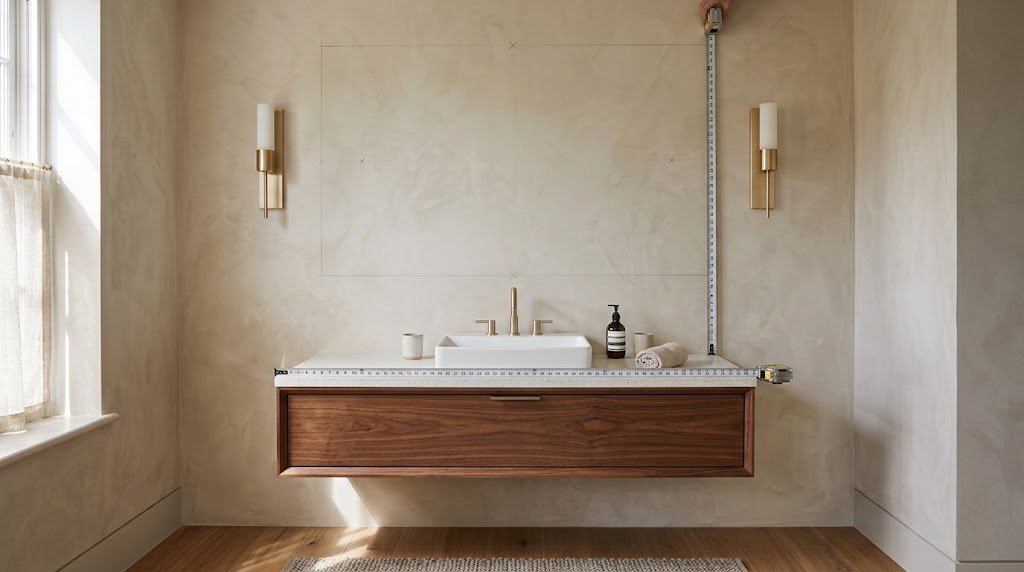
Accurate measurements make it much easier to understand how to choose bathroom mirror size for your specific space. Before ordering a mirror, measure the vanity, wall area, vertical clearance, and nearby fixtures. These measurements help prevent choosing a mirror that is too large, too small, or difficult to install.
Step 1: Measure the Vanity
Start by measuring the total width of the vanity from the outside edge to the opposite outside edge. Record the measurement in inches.
For most bathroom layouts, the mirror should be the same width as the vanity or slightly narrower. As a practical starting point, aim for a mirror that is approximately 70% to 100% of the vanity width.
Example:
A 36-inch vanity could work with a mirror approximately 25 to 36 inches wide.
If you have a double vanity, also measure the distance between the two sinks. This will help you decide whether one large mirror or two separate mirrors will work better.
Step 2: Measure Available Wall Width
Next, measure the usable horizontal wall space where the mirror will be installed. Measure between walls, cabinets, windows, or other permanent obstacles.
Do not assume that the entire wall width is available. If you plan to install sconces beside the mirror, reserve enough space for the fixtures.
If your available wall width is smaller than the vanity width, use the wall measurement as the limiting factor.
Step 3: Measure Vertical Wall Space
Measure the distance from the top of the backsplash or countertop area to the ceiling or another obstruction above the vanity.
Also check for medicine cabinets, shelves, wall lights, outlets, trim, and other features that could affect the mirror’s height.
This measurement will help you determine whether a standard, tall, or horizontal mirror is most appropriate.
Step 4: Account for Lighting and Fixtures
Before finalizing your measurements, mark the position of all nearby fixtures. Consider:
- Wall sconces
- Faucets
- Backsplashes
- Medicine cabinets
- Shelves
- Electrical outlets
- Windows
- Cabinets
- Ceiling lights
Lighting is especially important. A mirror that fits the wall perfectly may leave insufficient room for sconces or other fixtures.
For a double vanity, check the spacing around each sink and decide whether individual mirrors would provide a better layout.
Step 5: Determine Your Ideal Mirror Dimensions
Once you have all your measurements, compare them to determine the maximum practical mirror size.
A simple starting formula is:
Maximum mirror width = the smaller of the vanity width or available wall width
For a more conservative design:
Recommended mirror width = approximately 70%–100% of vanity width
Then check the available vertical space to determine an appropriate mirror height.
For example, if your vanity is 48 inches wide but only 44 inches of unobstructed wall space is available, a mirror wider than 44 inches would not be suitable for that location.
Bathroom Mirror Measurement Checklist
Before purchasing, check these measurements:
- ☐ Vanity width
- ☐ Available wall width
- ☐ Available wall height
- ☐ Sink position
- ☐ Distance between sinks
- ☐ Backsplash height
- ☐ Faucet position
- ☐ Sconce or lighting position
- ☐ Nearby cabinets and shelves
- ☐ Desired mirror width
- ☐ Desired mirror height
Taking these measurements first makes how to choose bathroom mirror size much simpler. Once you know the available dimensions and potential obstacles, you can select a mirror that fits the space comfortably and maintains good proportions with the vanity.
Bathroom Mirror Size Mistakes to Avoid
Knowing how to choose bathroom mirror size is not only about finding the right dimensions. You also need to avoid common sizing and placement mistakes that can make the vanity area look unbalanced or create installation problems.
Choosing a Mirror Wider Than the Available Wall Space
One of the easiest mistakes to make is choosing a mirror based on vanity width without checking the actual wall space. A mirror may fit the vanity but still be too wide for the surrounding wall.
Always measure the usable wall area first, especially if there are adjacent walls, cabinets, windows, or other permanent features.
Ignoring Vanity Proportions
A mirror that is too small or too large compared with the vanity can look out of place. In most cases, choosing a mirror that is approximately 70% to 100% of the vanity width provides a useful starting point.
However, the exact proportion depends on the mirror shape, bathroom layout, and surrounding fixtures.
Choosing the Wrong Height
Mirror height is just as important as width. A mirror that is too tall can make the wall feel crowded, while one that is too short may leave excessive empty space above the vanity.
Consider the distance between the countertop, backsplash, lighting, and ceiling before selecting the mirror height.
Forgetting About Bathroom Lighting
Lighting should be considered before finalizing the mirror size. If you plan to install sconces beside the mirror, you need enough wall space for both the mirror and lighting fixtures.
Choosing an extra-wide mirror without accounting for sconces can force the lights into awkward positions or make the vanity area feel crowded.
Installing the Mirror Too Close to the Faucet
Installing a mirror too close to the faucet or backsplash can create practical problems. Water splashes may reach the bottom edge of the mirror, while a tall faucet can make the area appear cramped.
Leave appropriate clearance between the mirror and countertop fixtures based on the vanity and backsplash design.
Using Two Mirrors Without Considering Spacing
Two mirrors can look excellent over a double vanity, but they should not be positioned without considering the space between them.
Measure the sink locations and available wall width before selecting each mirror. Both mirrors should generally have similar dimensions and be mounted at the same height to maintain symmetry.
Choosing Size Based Only on Appearance
A mirror may look attractive in a showroom or product photograph but still be unsuitable for your bathroom. Choosing based only on appearance can lead to problems with wall space, lighting, cabinet doors, or everyday usability.
Before purchasing, compare the mirror’s actual dimensions with your measurements. If possible, mark the proposed size on the wall using painter’s tape to visualize its footprint.
Ignoring Cabinet Doors, Sconces, and Other Obstacles
Permanent fixtures can significantly affect the usable space around a mirror. Medicine cabinets, cabinet doors, sconces, shelves, windows, outlets, and trim should all be considered before installation.
Measure around these obstacles rather than assuming the entire wall is available.
Ultimately, how to choose bathroom mirror size comes down to balancing dimensions with the entire vanity area. Measure before buying, consider the surrounding fixtures, and choose a size that provides enough viewing space without overwhelming the bathroom.
Bathroom Mirror Size vs. Vanity Size: Quick Reference Chart
If you want a quick answer to how to choose bathroom mirror size, start with the width of your vanity. In most cases, the mirror should be slightly narrower than the vanity or close to the same width. The right choice also depends on whether you have one sink or two and how much wall space is available.
| Vanity Width | Recommended Mirror Width | Single Sink | Double Sink | Suggested Mirror Configuration |
|---|---|---|---|---|
| 24 inches | 20–24 inches | Yes | No | 1 mirror |
| 30 inches | 24–30 inches | Yes | No | 1 mirror |
| 36 inches | 30–36 inches | Yes | No | 1 mirror |
| 48 inches | 42–48 inches | Yes | Sometimes | 1 large mirror |
| 60 inches | 54–60 inches | No | Yes | 1 large mirror or 2 mirrors |
| 72 inches | 60–72 inches | No | Yes | 1 large mirror or 2 mirrors |
How to Use This Chart
These measurements are practical starting points rather than strict rules. Your bathroom’s wall dimensions, sink placement, mirror shape, lighting, and surrounding fixtures can change the ideal size.
For a single-sink vanity, one centered mirror is usually the simplest option. Choose a width that complements the vanity without extending significantly beyond its edges.
For a double-sink vanity, you can choose one large mirror spanning both sinks or two individual mirrors. Two mirrors can work particularly well when each sink has its own wall sconce.
If your available wall space is narrower than the recommended mirror range, always prioritize the actual usable wall space. Likewise, if cabinets, windows, sconces, or other fixtures occupy part of the wall, reduce the mirror size as needed.
The key is to use the chart as a starting point, then verify your measurements before purchasing. This approach makes how to choose bathroom mirror size much easier while helping you create a balanced vanity area.
FAQs
How do I know what size bathroom mirror I need?
To understand how to choose bathroom mirror size, start by measuring the width of your vanity and the available wall space. As a general guideline, choose a mirror that is about 70% to 100% of the vanity width. Also consider the number of sinks, lighting fixtures, cabinets, backsplash, and the overall height of the wall.
Should a bathroom mirror be the same width as the vanity?
A bathroom mirror can be the same width as the vanity, but it does not have to be. A mirror that is slightly narrower than the vanity often creates a balanced appearance. For example, a 36-inch vanity can work well with a mirror between 30 and 36 inches wide.
Should a bathroom mirror be smaller than the vanity?
In most cases, yes. A mirror that is slightly smaller than the vanity is a safe and visually balanced choice. However, the mirror does not need to be significantly smaller. Keeping the mirror within roughly 70% to 100% of the vanity width usually provides good proportions.
What size mirror is best for a 36-inch vanity?
For a 36-inch vanity, a mirror around 30 to 36 inches wide is a practical choice. A 30-inch mirror leaves some space on both sides, while a 36-inch mirror creates a fuller look. Your wall space and lighting arrangement should also influence the final size.
What size mirror is best for a 48-inch vanity?
A 42- to 48-inch-wide mirror generally works well with a 48-inch vanity. Choose the narrower option if you have wall sconces or other fixtures beside the mirror. A mirror close to 48 inches wide can work well when the wall is open and uncluttered.
What size mirror is best for a 60-inch vanity?
For a 60-inch vanity, consider a mirror approximately 54 to 60 inches wide when using one large mirror. For a double vanity, you can also use two separate mirrors, with each mirror positioned over one sink.
Is a round mirror better than a rectangular mirror?
Neither shape is universally better. A round mirror can soften bathrooms with straight lines and create a modern or decorative appearance. A rectangular mirror usually provides more viewing area and works particularly well above wider vanities. Choose the shape that best fits your vanity, wall space, lighting, and bathroom style.
How high should a bathroom mirror be above the sink?
There is no single height that works for every bathroom. A common approach is to position the mirror so its center is near average eye level while leaving enough space between the bottom of the mirror and the faucet or backsplash. Ceiling height, vanity height, mirror size, and the height of the people using the bathroom should all be considered.
Can a bathroom mirror be wider than the vanity?
Yes, but it is usually better to keep the mirror within the width of the vanity when possible. A mirror wider than the vanity can work when there is plenty of uninterrupted wall space and the design intentionally uses an oversized mirror. Avoid making the mirror so wide that it interferes with sconces, cabinets, or other fixtures.
Should two mirrors be used over a double vanity?
Two mirrors are a popular choice for a double vanity because each mirror can align with one sink and create a symmetrical appearance. However, one large mirror can also work well and may provide a more continuous, spacious look. The best option depends on the vanity design, available wall space, lighting, and your preferred style.
Final Thoughts
Knowing how to choose bathroom mirror size comes down to finding the right balance between your vanity, wall space, and overall bathroom layout. A mirror that is properly sized can improve both functionality and the appearance of the room.
Before purchasing, always measure the vanity width, available wall space, vertical clearance, and surrounding fixtures. For most bathrooms, a mirror that is around 70% to 100% of the vanity width is a practical starting point, but the ideal size can vary depending on the layout.
Your sink configuration also matters. A single-sink vanity may work best with one centered mirror, while a double vanity can use either one large mirror or two individual mirrors. Mirror shape, lighting, cabinet placement, and personal preference should also influence your final choice.
For more detailed information about mirror types, features, materials, placement, installation, and maintenance, see our Ultimate Guide to Bathroom Mirrors.
The most important step is simple: measure your space before you buy. Taking a few minutes to check the dimensions can help you choose a bathroom mirror that looks proportional, functions well, and complements your entire bathroom design.