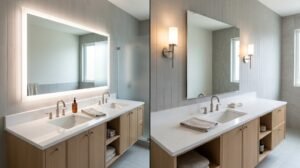
Introduction
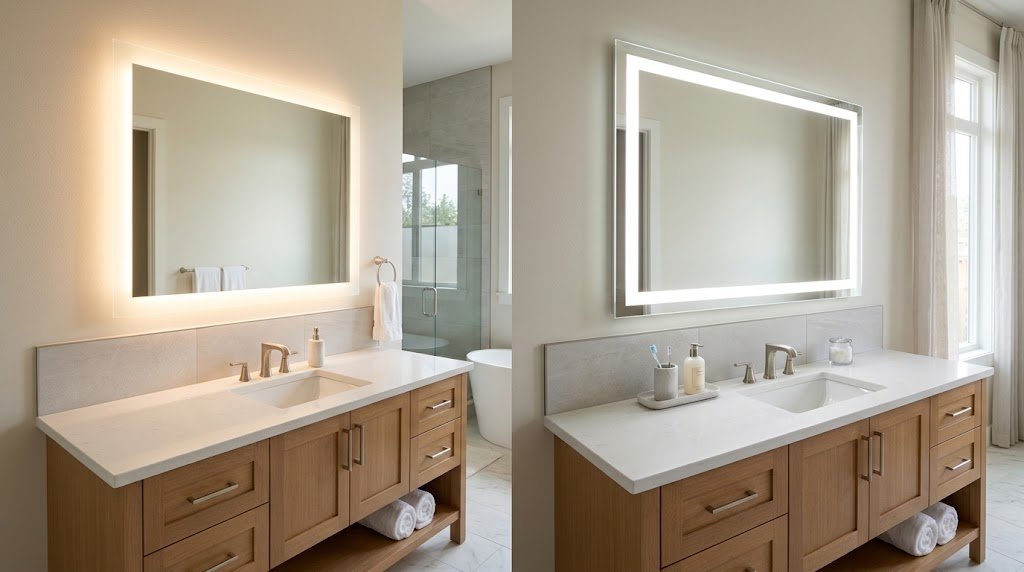
Choosing between backlit vs front-lit bathroom mirrors comes down to how you want your bathroom to look and how much light you need for everyday grooming. A backlit mirror creates a soft glow on the wall behind it, while a front-lit mirror directs light toward your face.
Neither type is automatically better for every bathroom. Front-lit mirrors are generally a practical choice for makeup, shaving, and skincare, while backlit mirrors excel at creating ambient lighting and a modern appearance. Your existing vanity lights, the mirror’s actual light output, and its design also affect performance.
Understanding these differences will help you choose a mirror that balances appearance, visibility, and functionality.
Table of Contents
What Is the Difference Between Backlit and Front-Lit Bathroom Mirrors?
The main difference is the direction in which the light travels. A backlit mirror primarily illuminates the wall behind the glass, whereas a front-lit mirror directs light outward toward the person standing in front of it. Some models combine both configurations.
How Backlit Bathroom Mirrors Work
A backlit bathroom mirror has LED light sources positioned behind the mirror, typically around its rear perimeter. The light shines toward the wall and creates a halo around the edges of the glass.
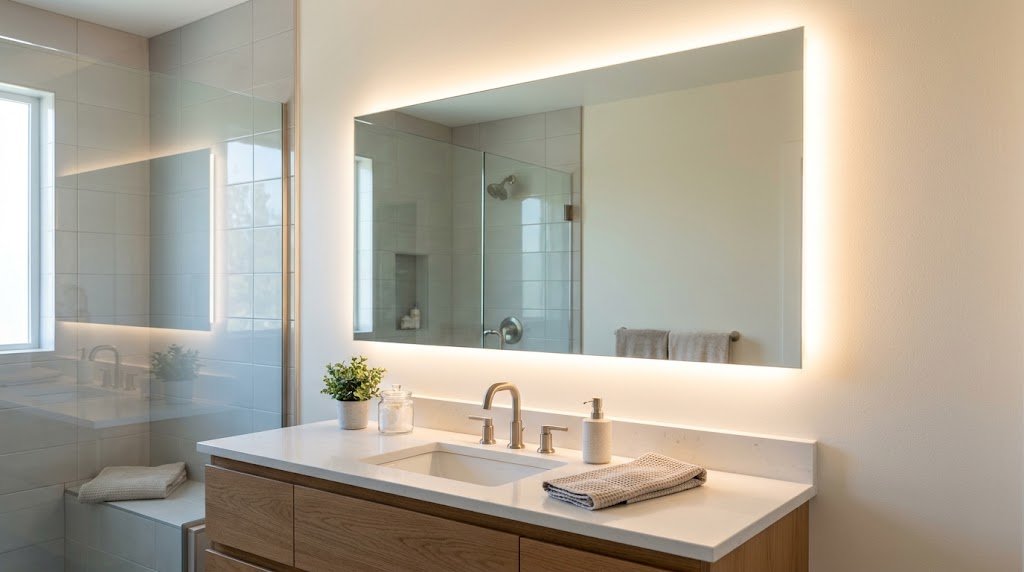
This indirect lighting gives the mirror a floating appearance and adds a soft layer of illumination to the bathroom. It can work particularly well in contemporary bathrooms where subtle accent lighting is part of the design.
Backlit mirrors are useful for:
- Creating a relaxing atmosphere in a bathroom.
- Highlighting the mirror against a contrasting wall.
- Adding decorative lighting without a prominent illuminated border on the mirror’s face.
- Complementing existing ceiling lights or vanity sconces.
However, light glowing behind a mirror does not necessarily provide enough illumination for your face. Much of the light is directed toward the wall rather than toward the person using the mirror. The amount of useful facial illumination depends on the product’s optical design, light output, and installation.
If you regularly apply makeup, shave, or perform detailed skincare, you may need separate vanity lighting alongside a backlit mirror.
How Front-Lit Bathroom Mirrors Work
A front-lit bathroom mirror uses LEDs arranged to send light forward. Depending on the model, the lights may sit behind frosted sections of the mirror, within an illuminated border, or behind another forward-facing diffuser.
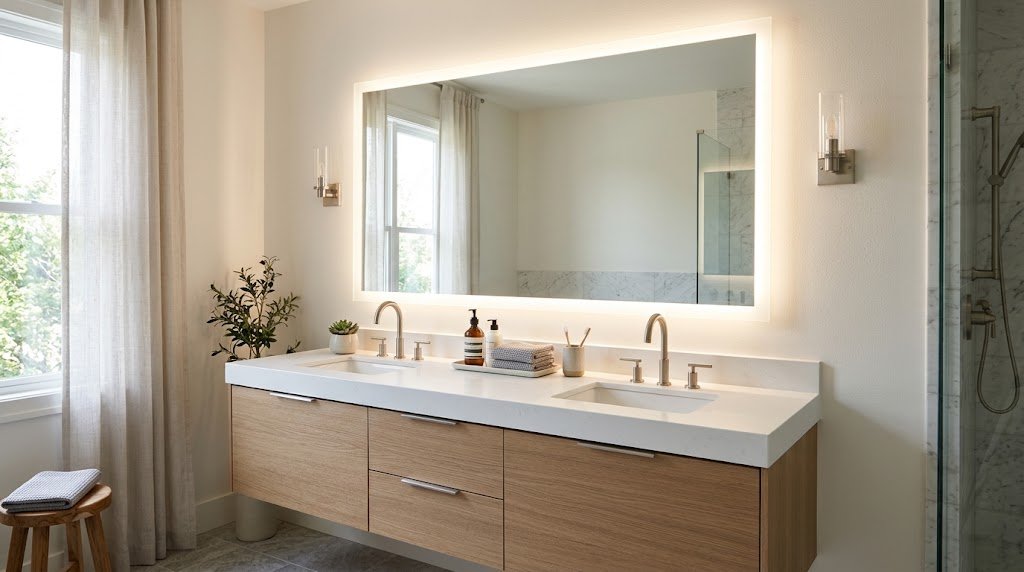
Because the light is directed toward the user, a front-lit mirror can provide more useful illumination for close-up tasks. It can make it easier to see facial details when shaving, applying makeup, grooming eyebrows, or following a skincare routine.
Common advantages include:
- More direct illumination of the face.
- A practical combination of mirror and task lighting.
- An integrated appearance without requiring separate light fixtures in every setup.
- Options for dimming or changing color temperature on models that support those features.
Not every front-lit mirror distributes light evenly. The location of the illuminated areas, brightness, diffuser design, and distance from the face all affect the result. A poorly positioned light source can still leave shadows.
Before purchasing, look at how the light is distributed across the mirror rather than judging a product only by how bright its illuminated border appears in a photograph.
What Is a Dual-Lit Bathroom Mirror?
A dual-lit bathroom mirror combines forward-facing illumination with rear lighting that creates a halo on the wall. It offers two lighting effects in one fixture.
This design can be useful when you want practical grooming light without giving up the decorative appearance of a backlit mirror. For example, a primary bathroom might benefit from direct light during a morning shaving routine and a softer glow in the evening.
Features vary by product. Some dual-lit mirrors allow the front and rear lights to operate independently, while others link them to the same control. Check the manufacturer’s specifications rather than assuming every model offers separate controls, adjustable color temperature, or dimming.
A dual-lit mirror may also cost more than a simpler design, so consider whether you will regularly use both lighting functions.
Backlit vs Front-Lit Bathroom Mirrors: Key Differences
The table below summarizes the main differences to consider when choosing an illuminated bathroom mirror.
| Feature | Backlit mirror | Front-lit mirror |
|---|---|---|
| LED placement | Behind the mirror | Behind forward-facing diffusers or illuminated sections |
| Primary light direction | Toward the wall | Toward the user |
| Main purpose | Ambient and decorative lighting | Task-oriented facial illumination |
| Appearance | Soft halo or floating effect | Illuminated border or panels |
| Makeup and shaving | May require additional task lighting | Generally better suited to close-up grooming |
| Existing vanity lights | Complements other lighting | Can supplement existing lights or provide some task lighting |
| Design emphasis | Atmosphere and wall illumination | Visibility and functionality |
| Potential limitation | May not adequately illuminate the face | May produce less of a wall halo |
| Alternative | Pair with suitable vanity lights | Choose a dual-lit model for both effects |
These are general differences rather than guarantees. A high-output backlit mirror with forward-facing light can perform differently from a basic halo-only model. Likewise, a front-lit mirror with poorly distributed light may not provide the facial illumination you expect.
The most useful comparison is not simply which mirror looks brighter. It is how much usable light reaches your face and whether that light suits your daily routine.
Which Is Better for Makeup, Shaving, and Everyday Grooming?
For makeup, shaving, and other close-up tasks, a well-designed front-lit mirror is generally the better starting point because it directs light toward your face. A backlit mirror can also work well when it is paired with suitable vanity lighting.
The goal is to select lighting that clearly illuminates your face while minimizing harsh shadows and uncomfortable glare.
Front-Lit Mirrors for Makeup and Skincare
Front-lit mirrors can be useful for applying foundation, blending makeup, grooming eyebrows, and completing detailed skincare routines. Their forward-facing light helps illuminate the face rather than directing most of the light toward the wall.
However, the quality of the light matters as much as its direction. Look for a mirror that distributes light evenly across the areas you need to see. A narrow illuminated strip may look bright without providing uniform illumination across your face.
Color rendering is also important when applying makeup. Color rendering index (CRI) measures how accurately a light source reveals colors compared with a standard reference light. A higher CRI generally indicates more faithful color rendering, although CRI does not capture every aspect of light quality. The c explains that LED products vary in both color quality and performance.
For makeup and skincare, look for:
- Forward-facing illumination that reaches your face.
- Even light distribution without distracting shadows.
- A CRI rating that helps you assess how naturally skin tones and makeup shades appear under the mirror’s lighting.
- A color temperature that suits your preferences and works with your usual lighting.
- Dimming or adjustable color settings if you want more flexibility.
A front-lit mirror is not automatically shadow-free or color-accurate. Check the specifications and, when possible, view the mirror in person before buying.
Front-Lit Mirrors for Shaving and Close-Up Tasks
Shaving requires enough light to see facial contours, hair, and small details clearly. A front-lit mirror can help because its light is directed toward the person standing at the vanity.
The arrangement of the light sources still matters. Light coming from only one direction can create shadows around the nose, chin, and other facial contours. Well-positioned lighting from both sides of the mirror can help produce more balanced facial illumination.
If you shave daily, consider how the mirror works with the rest of your bathroom lighting. A front-lit mirror may provide useful task lighting, but separate vanity lights can improve the overall result when the integrated light is insufficient.
Also consider whether you need a magnifying mirror for detailed work. Magnification is a separate feature and does not depend on whether the primary mirror is backlit or front-lit.
When a Backlit Mirror Can Work Well
A backlit mirror can be a good choice when your bathroom already has effective lighting for grooming. For example, if you have well-positioned vanity sconces that illuminate your face, the mirror’s rear halo can add atmosphere without needing to perform every lighting function itself.
Backlit mirrors also suit guest bathrooms and powder rooms where the main priorities may be appearance and gentle ambient illumination rather than a demanding daily grooming routine.
Consider this example: a primary bathroom has vertical lights on both sides of the mirror. In that setup, a backlit mirror can provide a decorative glow while the sconces do most of the work of illuminating the face.
The takeaway is simple: choose a mirror based on the complete lighting arrangement, not the mirror’s lighting style alone.
Which Mirror Looks Better in a Modern Bathroom?
Neither type is universally more attractive. A backlit mirror emphasizes the wall behind it, while a front-lit mirror makes the illuminated glass or border more visually prominent. The best choice depends on the bathroom’s design, wall finish, and existing fixtures.
The Soft, Floating Look of Backlit Mirrors
Backlit mirrors are popular in contemporary interiors because the light creates a subtle outline around the glass. The effect can make the mirror appear to float slightly away from the wall.
This style works particularly well with:
- Textured or subtly contrasting wall finishes.
- Minimalist vanities with clean lines.
- Natural materials such as wood and stone.
- Bathrooms where soft accent lighting is a design priority.
The type and finish of the wall influence how the mirror’s ambient light is reflected and spread across the surrounding area. A light-colored wall may reflect the light more broadly, while a darker or more textured surface can produce a different visual effect. The final result also depends on the distance between the mirror and the wall, the LED placement, and the light output.
A backlit mirror is therefore a strong aesthetic choice when you want the mirror to contribute to the room’s atmosphere without making the light source itself the main visual feature.
The Clean, Functional Look of Front-Lit Mirrors
Front-lit mirrors create a different look. Their illuminated borders or panels are visible from the front, giving the mirror a more defined appearance.
This design can complement contemporary bathrooms with streamlined fixtures, simple cabinetry, and integrated lighting. It can also make sense when the mirror is intended to serve as both a reflective surface and a source of task illumination.
Consider the appearance of the illuminated sections when the mirror is switched off. Some models have a subtle frosted border, while others feature more prominent light panels. The choice affects how the mirror looks throughout the day, not just when the LEDs are on.
If functional visibility is your priority, avoid choosing a mirror based on its illuminated border alone. A visually prominent border does not necessarily mean the light reaching your face will be adequate.
When a Dual-Lit Mirror Makes Sense
A dual-lit mirror can suit a bathroom where both decorative lighting and grooming visibility matter. Its front-facing light supports tasks, while the rear illumination creates a halo on the wall.
For example, a homeowner renovating a primary bathroom may want direct light for a morning routine and a softer appearance in the evening. A dual-lit design may provide both without requiring two separate mirror fixtures.
Before choosing one, check whether the front and rear lights can be controlled independently. Some models offer separate modes or adjustable brightness, while others have more limited controls.
Also account for the additional purchase cost, installation requirements, and available wall space. A dual-lit mirror is worthwhile when its extra features solve a real need, not simply because it offers more lighting options.
Do Backlit and Front-Lit Mirrors Provide Enough Light on Their Own?
Either type may provide useful light, but neither guarantees sufficient illumination for an entire bathroom or every grooming task. The answer depends on the mirror’s output, how its light is distributed, the room’s layout, and the lighting already installed.
A mirror may look bright in a product photo while delivering relatively little light to the user’s face. Evaluate the complete lighting setup rather than relying on appearance alone.
Understand the Difference Between Lumens and Illuminance
Lumens indicate the total quantity of visible light produced by a light source. Illuminance measures the amount of light reaching a particular surface and is commonly expressed in lux in technical specifications.
These measurements describe different things. A mirror can emit a substantial amount of light without directing enough of it toward the face or vanity area.
For example, a backlit mirror may send much of its output toward the wall. That light contributes to the room’s appearance, but it does not necessarily provide the same practical illumination as a forward-facing source.
When comparing products:
- Lumens: Check the stated light output and whether the figure refers to the complete fixture or another component.
- Illuminance: Look for measurements at the relevant task area when available.
- Light distribution: Consider where the LEDs are positioned and whether the design directs light toward the face.
- Room conditions: Account for other lights, wall surfaces, mirror placement, and the distance between the user and the mirror.
The U.S. Department of Energy notes that LED fixture design affects how effectively emitted light is delivered where it is needed.
When You May Need Additional Vanity Lighting
Additional vanity lighting is worth considering when your face remains unevenly illuminated, even with the mirror lights switched on.
Suitable options include vertical wall sconces beside the mirror, a properly positioned vanity light above it, or other fixtures designed to illuminate the task area. The best arrangement depends on the bathroom layout and the location of the light sources.
Side lighting can be particularly useful for reducing the pronounced facial shadows that sometimes occur when all the light comes from overhead. Residential lighting recommendations from the Illuminating Engineering Society explain different ways to light mirrors and grooming areas effectively.
If you are choosing a backlit mirror, consider adding task lighting when the rear halo is primarily decorative. If you prefer a front-lit mirror, check whether its actual output is sufficient before assuming it can replace your existing vanity lights.
General bathroom lighting still matters. The room needs appropriate illumination beyond the mirror, including around the vanity and other areas where you perform everyday tasks.
How Existing Bathroom Lighting Changes the Decision
Your current lighting setup can change which mirror makes the most sense.
Bathroom with existing vanity sconces: If the sconces already illuminate your face effectively, a backlit mirror may provide the decorative effect you want without sacrificing grooming visibility.
Bathroom with only a ceiling light: A front-lit mirror may provide useful additional facial illumination. However, the ceiling light and mirror should be assessed together because overhead lighting alone can create shadows.
Bathroom with limited wall space: An integrated front-lit mirror may be a practical option if it provides adequate task lighting and fits the available electrical and mounting arrangements.
Bathroom designed around ambience: A backlit mirror may be sufficient for the decorative purpose, provided other lighting serves the bathroom’s functional needs.
Wall color, surface texture, mirror size, and placement also affect the final result. A reflective wall may distribute the halo differently from a dark, textured wall, while a large mirror may illuminate a different area than a small one.
The practical rule is to evaluate the mirror in the context of the whole bathroom rather than assuming its lighting configuration alone determines performance.
What Should You Check Before Buying a Backlit or Front-Lit Mirror?
Before purchasing, compare the mirror’s light output, color quality, controls, additional features, and installation requirements. These specifications help you determine whether a mirror will suit your bathroom beyond its appearance.
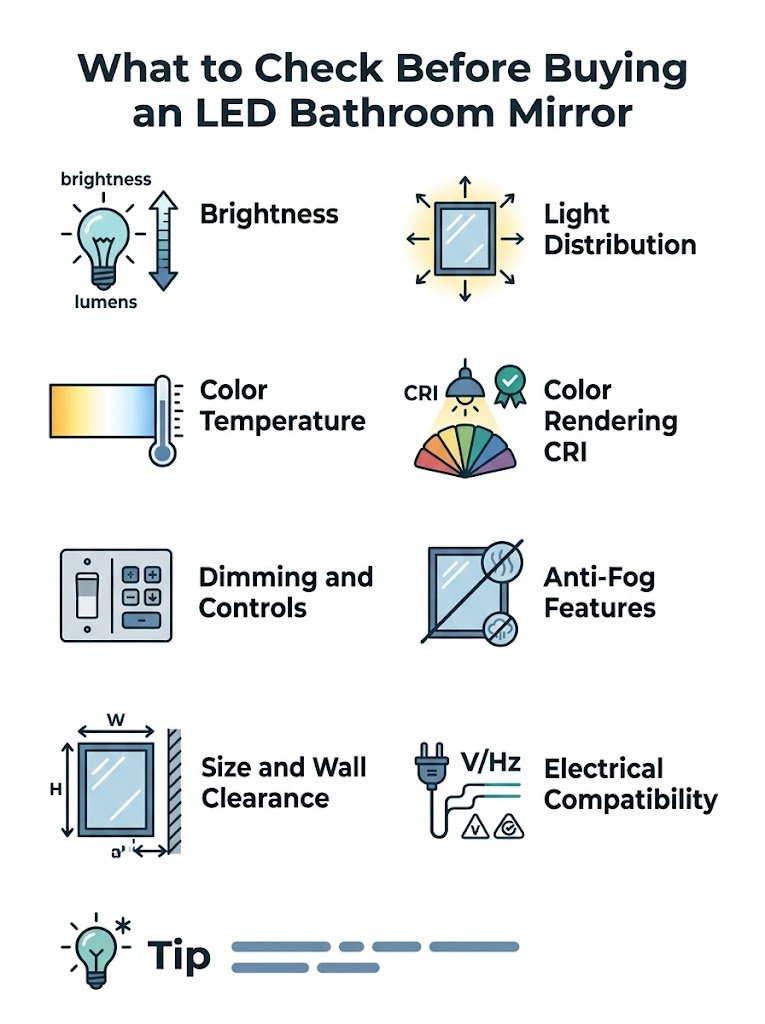
Brightness and Light Distribution
Begin by reviewing the manufacturer’s brightness specifications and the way the light spreads across the surrounding area.
A higher lumen rating indicates more light emitted, but it does not automatically mean better illumination of the face. The mirror’s optical design determines how much light travels forward, toward the wall, or elsewhere.
For the most useful comparison, check:
- The stated lumen output and what it measures.
- Whether the LEDs face forward, backward, or in both directions.
- Whether the illumination covers the face evenly or stays focused along a thin edge around the mirror.
- Whether the manufacturer provides useful photometric information or measurements.
- Whether supplementary vanity lighting will still be needed.
Avoid comparing two mirrors using lumen figures alone when their lighting designs differ substantially.
Color Temperature and Color Rendering
Color temperature describes the apparent warmth or coolness of white light and is measured in kelvins (K). Lower color temperature ratings produce a warmer, more yellowish light, while higher ratings create a cooler, more bluish appearance.
Common residential lighting options include warm white around 2700K, soft white around 3000K, and neutral white around 3500K. Product terminology varies, so check the actual Kelvin rating rather than relying solely on labels such as “natural white” or “daylight.”
Color rendering is a separate consideration. CRI measures how naturally and accurately a light source shows colors compared with a standard reference light. A higher CRI generally indicates better color fidelity, although it is not a complete measure of light quality.
For makeup and skincare, look for a suitable CRI and a color temperature that helps you judge colors consistently. If you regularly apply makeup under different lighting conditions, an adjustable color-temperature feature may be useful.
Remember that color temperature is not brightness. A cooler-looking light does not automatically provide more illumination, and neither a backlit nor a front-lit configuration guarantees better color rendering.
Dimming, Controls, and Adjustable Lighting
Some illuminated mirrors include touch-sensitive controls, dimming, adjustable color temperature, or memory functions. Others provide only a basic on/off switch.
Think about how you will use the mirror throughout the day. Adjustable brightness can be useful when you want strong illumination for grooming but a softer effect at other times.
Before buying, verify:
- Whether the mirror supports dimming.
- Whether color temperature is adjustable or fixed.
- Whether the front and rear lights can operate independently on dual-lit models.
- Whether the controls are integrated into the mirror or require a separate switch.
- Whether any external dimmer is compatible with the product.
Do not assume that all LED mirrors support these functions. Confirm them in the manufacturer’s specifications.
Anti-Fog Features and Mirror Maintenance
An anti-fog feature, often called a demister or defogger, uses a heating element behind the mirror to help prevent condensation from obscuring the reflective surface.
This is separate from the mirror’s lighting configuration. A backlit mirror may include a demister, and a front-lit mirror may not. The same applies to dual-lit models.
If your bathroom becomes steamy during showers, check whether the mirror includes a demister or offers one as an optional feature. Also verify how it operates, whether it has a separate control, and whether it requires additional electrical connections.
For regular cleaning, use the care guidelines provided by the manufacturer. Avoid allowing cleaning products or excess moisture to enter electrical components, controls, or exposed edges.
Size, Wall Clearance, and Electrical Compatibility
Measure the available wall space and vanity before choosing a mirror. Consider its width, height, mounting method, rear clearance, and the location of the electrical supply.
Backlit mirrors require adequate clearance from the wall to allow their rear LEDs to produce the desired halo effect. Front-lit and dual-lit mirrors also have specific mounting and wiring requirements that vary by model.
Before installation, check:
- Whether the mirror fits the vanity and wall dimensions.
- Whether its mounting system is suitable for the wall construction.
- Whether the electrical connection is plug-in or hardwired.
- Whether the product is rated for its intended bathroom location.
- Whether the instructions specify particular clearances or installation conditions.
- Whether the electrical work must be completed by a qualified professional under applicable local requirements.
Do not assume a mirror is suitable for every bathroom simply because it is marketed as a bathroom mirror. Verify its ratings and installation instructions before purchasing.
Quick Pre-Purchase Checklist
Refer to this checklist to evaluate different models and choose the mirror that best fits your needs.
- The mirror provides the type of lighting I need.
- Its light output and distribution suit my grooming routine.
- Its color temperature and CRI meet my preferences.
- I know whether dimming or adjustable color settings are included.
- I have checked whether an anti-fog feature is available.
- The mirror fits my vanity and available wall space.
- Its electrical requirements and bathroom suitability are confirmed.
- I know whether additional vanity lighting is necessary.
Choosing the Best Bathroom Mirror for Your Needs
The easiest way to choose is to start with your primary need. If you want direct light for grooming, look at front-lit mirrors first. If your priority is a soft wall glow and you already have suitable task lighting, consider a backlit mirror. If you want both effects, compare dual-lit models.
Choose Front-Lit If Facial Visibility Is Your Priority
A front-lit mirror is generally the stronger starting point if you regularly apply makeup, shave, or complete detailed skincare routines and need more direct illumination.
It is particularly worth considering when the bathroom has limited existing vanity lighting. However, check the model’s output and light distribution rather than assuming every front-lit design will provide enough light.
Best fit: A primary bathroom where daily grooming and practical facial illumination are the main priorities.
Choose Backlit If Ambience Is Your Priority
A backlit mirror is a good option if you want a decorative halo, a floating appearance, or subtle accent lighting. It works especially well when other fixtures already provide the illumination required for grooming.
This can be a sensible choice for a guest bathroom, powder room, or contemporary vanity where appearance matters more than having the mirror serve as the main task light.
Best fit: A bathroom where existing lighting handles functional tasks and the mirror is intended to enhance the atmosphere.
Choose Dual-Lit If You Want Both
A dual-lit mirror is worth considering when you want forward-facing light for grooming and a halo effect for visual appeal.
Check the control options carefully. Independent front and rear lighting can provide more flexibility, but not every dual-lit model supports it. Compare the features against your budget and daily needs.
Best fit: A primary bathroom where both functional illumination and decorative lighting are important.
Keep Your Existing Mirror and Improve the Lighting
Replacing your mirror is not always necessary. If you already have a conventional mirror that suits your bathroom, adding appropriate vanity lighting may be a more practical solution.
For example, a well-placed pair of wall sconces can illuminate the face while allowing you to keep your existing mirror. This may be particularly useful when the mirror is in good condition, the vanity dimensions are fixed, or changing the electrical arrangement would be inconvenient.
Before replacing the mirror, identify the actual problem. If your face is poorly illuminated, improving the direction and distribution of light may solve it without requiring a new mirror.
A Simple Three-Question Decision Guide
- Do you need more direct light on your face? Start by comparing front-lit mirrors and their light-output specifications.
- Do you already have adequate vanity lighting? If yes, a backlit mirror may provide the decorative effect you want without compromising grooming visibility.
- Do you want a halo effect as well as task lighting? Compare dual-lit mirrors and verify whether their lighting modes can be controlled independently.
Your answers will narrow the options considerably. The best mirror is the one that fits your lighting needs, bathroom layout, and preferences—not necessarily the one with the most features.
FAQs
Is a backlit or front-lit bathroom mirror better?
A front-lit mirror is generally better for makeup, shaving, and detailed grooming because it directs light toward your face. A backlit mirror is often better for creating ambient lighting and a decorative wall glow. The right choice depends on the mirror’s performance and your existing bathroom lights.
Are backlit mirrors good for makeup?
A backlit mirror can work well for makeup when paired with adequate vanity lighting. However, a halo-only design may not provide enough direct facial illumination. If makeup application is your priority, consider a front-lit mirror with suitable light distribution and color rendering.
Can a backlit mirror light a bathroom by itself?
A backlit mirror may contribute to the room’s ambient lighting, but it should not automatically be treated as the bathroom’s only light source. Whether it provides sufficient illumination depends on its output, the room’s layout, and the tasks being performed. Additional general and vanity lighting may be necessary.
Do front-lit mirrors show colors more accurately?
Not necessarily. Front-lit mirrors direct light toward the face, but color accuracy depends on the light source’s color-rendering properties and other aspects of its design. Check the CRI and available color-temperature specifications rather than assuming that front-facing LEDs guarantee accurate color reproduction.
Can a bathroom mirror be both front-lit and backlit?
Yes. Dual-lit bathroom mirrors combine forward-facing illumination with rear lighting that creates a halo on the wall. Depending on the model, the two lighting functions may have separate controls or operate together. Verify the product specifications before buying.
Do LED bathroom mirrors need additional lighting?
Sometimes. A front-lit mirror may provide useful task lighting, while a backlit mirror may primarily provide ambient illumination. Additional ceiling lights or vanity fixtures may still be needed to illuminate the entire bathroom and provide adequate visibility for grooming.
Conclusion
When comparing backlit vs front-lit bathroom mirrors, the most important difference is how each directs light. Backlit mirrors create a soft halo that enhances a bathroom’s atmosphere, while front-lit mirrors generally provide more direct illumination for makeup, shaving, and everyday grooming.
Choose a backlit mirror if you prioritize ambience and already have suitable task lighting. Choose a front-lit mirror if facial visibility is your main concern. If you want both functions, consider a dual-lit model with the controls and light output you need.
Before making a purchase, compare brightness, light distribution, CRI, color temperature, anti-fog features, and installation requirements. A carefully selected mirror should complement your bathroom’s existing lighting rather than simply look impressive when switched on.