
Introduction
Bathroom mirror types explained in one simple guide can make choosing the right mirror much easier. With so many options including framed, frameless, LED, backlit, smart, and medicine cabinet mirrors, it can be difficult to know which one suits your bathroom best.
In this guide, we’ll explore the most popular bathroom mirror types, their key benefits, drawbacks, and ideal uses. You’ll also learn how to choose the right mirror based on your bathroom size, vanity, lighting, style, storage needs, and budget.
Table of Contents
Bathroom Mirror Types Explained: A Quick Overview

When exploring different bathroom mirror types, it is helpful to understand that each option serves a different purpose. Some mirrors are designed mainly for decoration, while others provide better lighting, extra storage, adjustable positioning, or advanced features.
The best choice depends on your bathroom size, vanity style, lighting needs, available wall space, and personal preferences. The table below gives you a quick overview of the most common options before we explain each type in more detail.
| Mirror Type | Best For | Main Benefit |
|---|---|---|
| Framed Mirror | Traditional bathrooms | Decorative appearance |
| Frameless Mirror | Modern bathrooms | Clean, minimalist look |
| LED Mirror | Modern vanities | Built-in lighting |
| Backlit Mirror | Ambient lighting | Soft, indirect glow |
| Lighted Mirror | Grooming and makeup | Better visibility |
| Medicine Cabinet Mirror | Small bathrooms | Extra storage |
| Vanity Mirror | Everyday use | Functional and versatile |
| Pivot Mirror | Flexible positioning | Adjustable viewing angle |
| Smart Mirror | High-tech bathrooms | Advanced features |
| Magnifying Mirror | Grooming | Close-up visibility |
| Round Mirror | Small or modern spaces | Soft visual appearance |
| Rectangular Mirror | Most bathrooms | Maximum reflection area |
| Arched Mirror | Decorative bathrooms | Elegant design |
| Full-Length Mirror | Large bathrooms | Full-body reflection |
| Double Vanity Mirrors | Double-sink bathrooms | Individual mirror space |
This bathroom mirror types explained the guide covers each of these options in more detail. From simple framed and frameless designs to modern LED, smart, and storage mirrors, understanding the differences can make it easier to choose a mirror that fits both your bathroom’s style and your everyday needs.
1. Framed Bathroom Mirrors
What Is a Framed Bathroom Mirror?
A framed bathroom mirror has a visible border surrounding the mirror glass. The frame can be made from materials such as wood, metal, aluminium, plastic, or moisture-resistant composite materials.
Framed mirrors are available in many colors, finishes, shapes, and designs. Because the frame adds a decorative element, this type of mirror can become an important part of the overall bathroom design.
In this bathroom mirror types explained guide, framed mirrors are one of the most versatile options because they can work in both simple and highly decorative spaces.
Advantages of Framed Mirrors
Framed bathroom mirrors offer several benefits:
- Adds decorative style: The frame can complement your vanity, fixtures, wall color, or other bathroom elements.
- Wide range of designs: You can choose from modern, traditional, farmhouse, industrial, or luxury styles.
- Creates a finished look: A frame can make a standard mirror appear more polished and visually appealing.
- Can hide mirror edges: The frame covers the edges of the glass, creating a cleaner appearance.
- Easy to match with bathroom décor: Different frame materials and finishes make it easier to coordinate the mirror with your overall design.
Disadvantages of Framed Mirrors
Although framed mirrors are attractive, there are a few things to consider:
- Requires more cleaning: Dust and moisture can collect around the frame and corners.
- Some materials may be affected by humidity: Wood or low-quality materials can warp, peel, or deteriorate in a damp bathroom.
- May look bulky in small spaces: Thick or heavily decorated frames can make a small bathroom feel visually crowded.
- Style may become outdated: Highly decorative designs may not suit future bathroom renovations.
For this reason, it is important to choose a frame material that is suitable for humid environments and a design that fits the size and style of your bathroom.
Best Bathroom Styles for Framed Mirrors
Framed mirrors work particularly well in bathrooms where the mirror is intended to add personality and decoration. They are a popular choice for:
- Traditional bathrooms: Ornate wood or decorative metal frames can complement classic fixtures.
- Farmhouse bathrooms: Natural wood, distressed finishes, or simple rustic frames work well with this style.
- Industrial bathrooms: Black metal or dark-colored frames can create a bold, modern appearance.
- Transitional bathrooms: Simple framed mirrors can combine traditional and modern elements.
- Luxury bathrooms: High-quality metal, wood, or detailed frames can create a more elegant look.
Overall, a framed mirror is a good choice if you want your mirror to serve as both a practical necessity and a decorative feature. When comparing the different options in this bathroom mirror types explained guide, framed mirrors stand out for their ability to add character and complement almost any bathroom style.
2. Frameless Bathroom Mirrors
What Is a Frameless Bathroom Mirror?
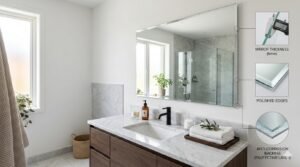
A frameless bathroom mirror is a mirror without a visible outer frame. The edges of the mirror glass are usually polished, beveled, or finished to create a clean appearance.
Because there is no decorative border, frameless mirrors have a simple and versatile design. They are available in many shapes and sizes, including rectangular, round, oval, and custom designs. In this bathroom mirror types explained guide, frameless mirrors are one of the most popular choices for homeowners who prefer a clean and modern look.
Benefits of Frameless Mirrors
Frameless bathroom mirrors offer several advantages:
- Clean and minimalist appearance: Without a frame, the mirror creates a simple and uncluttered look.
- Works with many styles: A frameless design can fit modern, minimalist, contemporary, and even traditional bathrooms.
- Makes small bathrooms feel more open: The simple design can reduce visual clutter and help the space feel larger.
- Easy to coordinate: You do not need to match a frame with your vanity, faucets, or other fixtures.
- Easy to clean: With no frame or decorative edges, there are fewer areas where dust and moisture can collect.
- Focuses on functionality: The mirror provides a large reflective surface without adding unnecessary visual elements.
Potential Drawbacks
Although frameless mirrors are practical and stylish, they may not be the right choice for every bathroom.
- Less decorative: Some homeowners may find a frameless mirror too plain compared with a framed design.
- Visible edges: Depending on the installation and mirror quality, the exposed edges may become more noticeable over time.
- Limited visual impact: In a highly decorative bathroom, a frameless mirror may not provide the same statement look as a bold frame.
- Installation requires care: Larger frameless mirrors can be heavy and may require proper mounting for safety and stability.
Choosing a high-quality mirror with properly finished edges and suitable backing can help improve durability in a humid bathroom environment.
Who Should Choose a Frameless Mirror?
A frameless bathroom mirror is a good choice for homeowners who prefer a simple, clean, and flexible design. It can work especially well in:
- Modern bathrooms with clean lines and simple fixtures.
- Minimalist bathrooms where reducing visual clutter is important.
- Small bathrooms where a lighter, more open appearance is preferred.
- Rental or versatile spaces where a neutral design can work with different décor styles.
- Large vanities where a wide reflective surface is more important than decorative framing.
Overall, frameless mirrors are a practical option for many homes. When comparing the different options in this bathroom mirror types explained guide, they stand out for their clean appearance, versatility, and ability to suit a wide range of bathroom designs.
3. LED Bathroom Mirrors
How LED Bathroom Mirrors Work
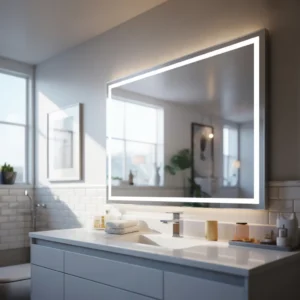
LED bathroom mirrors have built-in light-emitting diode (LED) lighting integrated into the mirror. Depending on the design, the lights may be placed around the edges, behind the mirror, or in specific sections of the glass.
Most LED mirrors connect to your home’s electrical system, although some models may use a plug-in connection. Many also include additional features such as touch controls, dimmable lighting, adjustable color temperature, and anti-fog functions.
In this bathroom mirror types explained guide, LED mirrors stand out because they combine two important bathroom features: a reflective surface and built-in lighting.
Benefits of LED Mirrors
LED bathroom mirrors offer several practical and visual benefits:
- Improved visibility: Built-in lighting can provide clearer illumination for tasks such as shaving, applying makeup, or skincare.
- Modern appearance: LED mirrors create a clean and contemporary look that works well in updated bathrooms.
- Energy efficiency: LED lights generally use less electricity than many traditional lighting options.
- Space-saving design: Combining a mirror and lighting into one unit can reduce the need for separate lighting around the vanity.
- Useful extra features: Depending on the model, you may get dimming controls, adjustable light color, touch sensors, or anti-fog technology.
- Even illumination: Some designs provide more balanced lighting across the face than a single overhead bathroom light.
Are LED Bathroom Mirrors Worth It?
LED bathroom mirrors can be worth the investment if you want better lighting and a modern, streamlined design. They are especially useful around vanities where good visibility is important.
However, they are not necessary for every bathroom. A standard mirror with properly placed vanity lighting can also provide excellent functionality. The value of an LED mirror depends on your budget, bathroom layout, and whether you will actually use its additional features.
For homeowners planning a modern bathroom upgrade, an LED mirror can offer both practical lighting and a decorative focal point. When comparing options in this bathroom mirror types explained guide, LED mirrors are a strong choice for people who want a combination of style, convenience, and everyday functionality.
Things to Consider Before Buying
Before choosing an LED bathroom mirror, consider the following factors:
- Mirror size: Make sure the mirror fits your vanity and available wall space.
- Lighting placement: Check whether the light is front-facing, edge-lit, or backlit, as each design provides a different lighting effect.
- Brightness: Look for a mirror that provides enough light for your daily grooming needs.
- Color temperature: Some models allow you to switch between warmer and cooler lighting tones.
- Dimming options: Adjustable brightness can make the mirror more useful at different times of the day.
- Power connection: Check whether the mirror needs to be hardwired or can be plugged into a standard outlet.
- Bathroom suitability: Choose a model designed for use in humid environments and follow the manufacturer’s installation and safety requirements.
- Additional features: Consider whether functions such as anti-fog technology, touch controls, or memory settings are genuinely useful for your needs.
- Installation requirements: Some LED mirrors may require professional electrical installation.
Overall, LED bathroom mirrors are a practical option for modern bathrooms, particularly when you want to improve both lighting and appearance. The right model should provide suitable brightness, fit your available space, and include features that add real value to your daily routine.
4. Backlit Bathroom Mirrors
What Is a Backlit Mirror?
A backlit bathroom mirror has built-in lighting positioned behind the mirror rather than directly in front of it. The light shines onto the wall around the edges of the mirror, creating a soft glow or halo effect.
Most backlit mirrors use LED lighting because it is compact and energy-efficient. Depending on the design, they may also include features such as dimmable brightness, adjustable color temperature, touch controls, and anti-fog functions.
In this bathroom mirror types explained guide, backlit mirrors are a popular option for homeowners who want to add soft lighting and a modern appearance to their bathroom.
How Backlit Mirrors Differ From LED Mirrors
A backlit mirror is often an LED mirror, but the two terms do not always mean exactly the same thing.
An LED mirror is a broad term for any bathroom mirror with built-in LED lighting. The lights may be positioned around the edges, behind the mirror, or directly on the front of the mirror.
A backlit mirror, on the other hand, specifically has lights installed behind the mirror. This creates indirect lighting that reflects off the wall and produces a softer visual effect.
The main difference is the placement and purpose of the lighting. Front-facing LED mirrors are generally better for tasks such as shaving or applying makeup, while backlit mirrors are often chosen for ambient lighting and appearance.
Advantages and Disadvantages
Backlit bathroom mirrors offer several benefits:
- Creates a modern appearance: The soft glow can give the bathroom a clean and contemporary look.
- Provides ambient lighting: Backlighting can make the bathroom feel warmer and more relaxing.
- Reduces harsh shadows: The indirect light is softer than direct lighting in many situations.
- Works well as a decorative feature: A backlit mirror can become a visual focal point above the vanity.
- May include useful features: Some models offer dimming, adjustable color temperature, or anti-fog technology.
However, there are also some potential drawbacks:
- May not provide enough task lighting: Backlighting alone may not be sufficient for detailed grooming or makeup application.
- Can cost more than standard mirrors: Built-in lighting and additional features may increase the overall price.
- Installation can be more complex: Some models require electrical connections and professional installation.
- Repairs may be more complicated: If the lighting system develops a problem, repairing or replacing components may be more difficult than with a standard mirror.
Best Places to Use a Backlit Mirror
A backlit mirror works best in bathrooms where appearance and ambient lighting are important. It can be a good choice for:
- Modern bathrooms with clean lines and contemporary fixtures.
- Minimalist bathrooms where a simple mirror with built-in lighting can create visual interest.
- Luxury bathrooms where lighting is used to create a more relaxing atmosphere.
- Powder rooms where the mirror can serve as a decorative focal point.
- Bathrooms with layered lighting, where separate vanity or ceiling lights provide enough illumination for grooming.
Overall, a backlit mirror is best used as part of a complete bathroom lighting plan rather than as the only source of light. When comparing options in this bathroom mirror types explained guide, backlit mirrors stand out for their soft illumination, modern design, and ability to create a more inviting bathroom atmosphere.
5. Front-Lit or Lighted Bathroom Mirrors
What Is a Front-Lit Mirror?
A front-lit bathroom mirror has built-in lights positioned on the front or around the surface of the mirror. Unlike a backlit mirror, which directs light toward the wall, a front-lit mirror sends light toward the person standing in front of it.
The lighting may appear as illuminated strips along the sides, top, or edges of the mirror. Many modern front-lit mirrors use LED technology and may include features such as dimmable brightness, adjustable color temperature, touch controls, and anti-fog functions.
In this bathroom mirror types explained guide, front-lit mirrors are a practical option for bathrooms where clear visibility is important for everyday tasks.
Backlit vs Front-Lit Mirrors
The main difference between backlit and front-lit mirrors is the direction of the light.
A backlit mirror places the lighting behind the mirror, creating a soft glow around its edges. This type of lighting is mainly used to create ambiance and add a modern decorative effect.
A front-lit mirror directs light forward toward the user. This makes it more useful for activities that require clear facial visibility, such as shaving, applying makeup, skincare, or other grooming tasks.
| Feature | Backlit Mirror | Front-Lit Mirror |
|---|---|---|
| Light Direction | Toward the wall | Toward the user |
| Main Purpose | Ambient lighting | Task lighting |
| Appearance | Soft halo effect | Brighter and more direct |
| Grooming Visibility | May be limited alone | Generally better |
| Best For | Modern and relaxing spaces | Daily grooming and makeup |
Some bathroom mirrors combine both front and back lighting, providing a balance between practical task lighting and a decorative ambient glow.
Which Provides Better Task Lighting?
For detailed tasks such as shaving, applying makeup, or skincare, a front-lit mirror generally provides better task lighting because the light shines directly toward the face. This can improve visibility and help reduce shadows caused by overhead lighting.
Backlit mirrors can create an attractive and relaxing atmosphere, but their indirect lighting may not be strong enough for detailed grooming when used alone.
When comparing options in this bathroom mirror types explained guide, a front-lit or lighted mirror is usually the better choice if your main priority is everyday functionality. However, for the best overall result, consider using the mirror as part of a layered bathroom lighting setup that combines task, ambient, and general lighting.
6. Medicine Cabinet Mirrors
What Is a Medicine Cabinet Mirror?
A medicine cabinet mirror combines a bathroom mirror with built-in storage. It usually has one or more mirrored doors that open to reveal shelves inside the cabinet.
These cabinets are commonly installed above the bathroom vanity or sink, making everyday items easy to access while keeping them out of sight. In this bathroom mirror types explained guide, medicine cabinet mirrors stand out because they provide both reflection and storage in a single unit.
Depending on the design, a medicine cabinet may include adjustable shelves, multiple compartments, soft-close doors, built-in lighting, or additional features.
Storage Benefits
The main advantage of a medicine cabinet mirror is the extra storage space it provides. It can be useful for keeping everyday bathroom items organized, such as:
- Toiletries
- Skincare products
- Toothbrushes and dental supplies
- Personal grooming items
- Small bathroom essentials
By storing these items inside the cabinet, you can reduce clutter on the vanity and countertop. This can help create a cleaner and more organized bathroom, especially when storage space is limited.
A medicine cabinet is also useful for keeping frequently used items within easy reach without requiring an additional storage unit.
Recessed vs Surface-Mounted Medicine Cabinets
Medicine cabinet mirrors are generally available in two main installation styles: recessed and surface-mounted.
A recessed medicine cabinet is installed partly inside the wall. This creates a more streamlined appearance because the cabinet does not extend as far into the bathroom. However, installation can be more complicated because the wall structure and available space need to be considered.
A surface-mounted medicine cabinet is attached directly to the wall. This type is usually easier to install and may provide more interior storage because the cabinet extends outward from the wall. The main drawback is that it can project farther into the room.
| Feature | Recessed Medicine Cabinet | Surface-Mounted Medicine Cabinet |
|---|---|---|
| Installation | More complex | Usually easier |
| Appearance | Built-in and streamlined | Extends outward from the wall |
| Interior Space | May be more limited | Often provides more depth |
| Best For | Clean, integrated designs | Simple installation and added storage |
Best for Small Bathrooms
Medicine cabinet mirrors are an excellent option for small bathrooms because they combine two essential functions without taking up additional floor space. Instead of installing a separate mirror and storage cabinet, you get both in one wall-mounted unit.
They can help keep countertops clear and make a compact bathroom feel more organized. A recessed model can be particularly useful when you want extra storage without having the cabinet extend too far into the room.
When comparing options in this bathroom mirror types explained guide, medicine cabinet mirrors are one of the most practical choices for bathrooms where storage is just as important as appearance. They are especially suitable for small bathrooms, powder rooms, and spaces with limited vanity or countertop storage.
7. Vanity Mirrors
What Makes a Mirror a Vanity Mirror?
A vanity mirror is a bathroom mirror designed primarily for use above a vanity or sink. Its main purpose is to provide a clear reflection for everyday activities such as brushing your teeth, shaving, applying makeup, or completing your skincare routine.
Vanity mirrors come in many styles, including framed, frameless, LED, backlit, and lighted designs. This means a vanity mirror is defined more by its placement and purpose than by one specific design.
In this bathroom mirror types explained guide, vanity mirrors are among the most common options because they combine everyday functionality with decorative appeal.
Choosing the Right Vanity Mirror Size
Choosing the right mirror size is important for both appearance and functionality. A mirror that is too small may look out of proportion, while one that is too large can overwhelm the vanity or surrounding wall space.
In general, the mirror should be proportionate to the vanity beneath it. Many homeowners choose a mirror that is slightly narrower than the vanity, although the best size can vary depending on the bathroom layout and overall design.
When choosing the size, consider:
- Vanity width: The mirror should look balanced with the vanity.
- Available wall space: Leave enough room around the mirror so the area does not feel crowded.
- Mirror height: Choose a height that provides a practical reflection for the people using the bathroom.
- Lighting placement: Make sure the mirror does not interfere with wall sconces, vanity lights, or other fixtures.
- Bathroom scale: Larger bathrooms can usually accommodate larger mirrors, while smaller spaces may benefit from a more carefully proportioned design.
A properly sized vanity mirror can make the bathroom feel more balanced and provide enough reflective space for everyday use.
Single vs Double Vanity Mirrors
The best mirror arrangement often depends on whether your bathroom has a single or double vanity.
A single vanity usually works well with one centered mirror. The mirror can be rectangular, round, oval, or another shape that matches the size and style of the vanity.
A double vanity gives you more flexibility. You can install one large mirror that spans most of the vanity, or use two separate mirrors—one above each sink.
Using two separate mirrors can create a more balanced and symmetrical appearance, especially when each sink has its own lighting. A single large mirror can make the wall feel more open and provide a continuous reflective surface.
When comparing options in this bathroom mirror types explained guide, vanity mirrors are one of the most flexible choices because they can be adapted to almost any bathroom layout. The key is to choose a size, shape, and style that fits your vanity while providing enough visibility for everyday use.
8. Pivot Bathroom Mirrors
How Pivot Mirrors Work
A pivot bathroom mirror is mounted on brackets attached to the wall, allowing the mirror to tilt forward or backward. Unlike a standard fixed mirror, the angle can be adjusted to provide a more comfortable viewing position.
The mirror usually has pivot points on both sides, which allow it to rotate within a limited range. Some designs include decorative brackets in finishes such as chrome, brass, black, or nickel, making the hardware part of the overall bathroom design.
In this bathroom mirror types explained guide, pivot mirrors are a practical option because they combine everyday functionality with an adjustable design.
Benefits of an Adjustable Mirror
The main advantage of a pivot mirror is its ability to change angles. This can offer several benefits:
- Adjustable viewing angle: Users can tilt the mirror to achieve a more comfortable reflection.
- Useful for households with different users: The adjustable design can help accommodate people of different heights.
- Adds visual interest: The side brackets give pivot mirrors a distinctive appearance compared with standard wall-mounted mirrors.
- Works with different bathroom styles: Simple designs can suit modern bathrooms, while decorative brackets can complement traditional or vintage spaces.
- Practical for daily grooming: Adjusting the mirror angle can improve visibility during tasks such as shaving, applying makeup, or skincare.
Are Pivot Mirrors Practical?
Pivot mirrors can be very practical, especially when the bathroom is used by people of different heights. The ability to adjust the viewing angle provides more flexibility than a fixed mirror.
However, they may require more wall space than a standard flat-mounted mirror because of the mounting brackets and tilting movement. The hardware should also be properly installed to support the weight of the mirror and allow smooth adjustment.
When comparing options in this bathroom mirror types explained guide, pivot mirrors are a good choice for homeowners who want a combination of functionality and style. They are particularly useful when adjustability is important and can work well in modern, traditional, transitional, and vintage-inspired bathrooms.
9. Smart Bathroom Mirrors
Common Smart Mirror Features
A smart bathroom mirror combines a traditional mirror with built-in technology. These mirrors can offer additional functions that improve convenience, lighting, and everyday bathroom use.
Common smart mirror features include:
- Touch controls: Allow you to turn lights or other features on and off by touching the mirror.
- Anti-fog technology: A built-in heating element helps reduce condensation on part or all of the mirror surface.
- Bluetooth connectivity: Some models allow you to connect a phone or other compatible device for audio playback.
- Digital displays: Certain smart mirrors can display information such as the time, date, or temperature.
- Adjustable lighting: You may be able to change the brightness or color temperature to suit different tasks and preferences.
Some models may include additional features, but the available technology varies depending on the mirror. In this bathroom mirror types explained guide, smart mirrors stand out as one of the most feature-rich options.
Pros and Cons of Smart Mirrors
Smart bathroom mirrors offer several advantages:
- Convenient features: Multiple functions can be combined into one unit.
- Modern appearance: Smart mirrors often have a sleek and contemporary design.
- Improved lighting control: Adjustable brightness and color temperature can make the mirror more useful throughout the day.
- Anti-fog convenience: This feature can help keep the mirror clearer after a shower.
- Entertainment options: Bluetooth connectivity can allow compatible devices to play audio through the mirror.
However, there are also some disadvantages to consider:
- Higher cost: Smart mirrors are generally more expensive than standard bathroom mirrors.
- More complex installation: Models with electrical features may require professional installation.
- Potential maintenance issues: More built-in technology means more components that could eventually require repair or replacement.
- Features may not suit everyone: Some users may prefer a simple mirror and separate bathroom lighting.
Who Should Buy a Smart Bathroom Mirror?
A smart bathroom mirror can be a good choice for homeowners who enjoy modern technology and want additional convenience in their daily routine. It may be especially suitable for:
- Modern or luxury bathrooms
- Smart home environments
- Bathrooms with limited wall space, where combining multiple functions into one unit is useful
- Homeowners planning a complete bathroom renovation
- People who want features such as adjustable lighting or anti-fog technology
When choosing a smart mirror, focus on features you are likely to use rather than paying extra for unnecessary technology. You should also check the mirror’s size, lighting quality, installation requirements, and suitability for a humid bathroom environment.
Overall, when comparing the options in this bathroom mirror types explained guide, smart mirrors are best for people who want more than a simple reflective surface. They combine everyday functionality with modern features, making them a convenient but often more expensive bathroom upgrade.
10. Magnifying Bathroom Mirrors
What Are Magnifying Mirrors Used For?
A magnifying bathroom mirror is designed to provide a closer and more detailed view than a standard mirror. It enlarges the reflection, making it easier to see small details during grooming and personal care.
These mirrors are commonly used for tasks such as:
- Applying makeup
- Shaving
- Skincare routines
- Tweezing
- Applying contact lenses
- Other detailed grooming tasks
Magnifying mirrors are often used as a secondary mirror alongside a standard bathroom mirror. In this bathroom mirror types explained guide, they stand out because their main purpose is detailed visibility rather than providing a full reflection.
Different Magnification Levels
Magnifying bathroom mirrors are available in different magnification strengths. The higher the magnification, the larger and closer the reflected image appears.
Common options include:
- 1x magnification: Provides a normal reflection without enlargement.
- 3x magnification: Offers mild enlargement and is suitable for general grooming.
- 5x magnification: Provides a closer view for makeup application and other detailed tasks.
- 7x to 10x magnification: Offers a highly detailed view and is useful for precise grooming, although it usually requires the user to stand closer to the mirror.
Higher magnification is not always better. Stronger magnification can reduce the visible area and may make the reflection harder to use from a normal standing distance. Choosing the right level depends on the tasks you plan to perform.
Wall-Mounted vs Portable Magnifying Mirrors
Magnifying bathroom mirrors are commonly available as either wall-mounted or portable designs.
A wall-mounted magnifying mirror is attached to the wall, often with an adjustable or extendable arm. This allows the mirror to be pulled closer when needed and moved back when not in use. It is a convenient option for a permanent grooming area.
A portable magnifying mirror can be placed on a countertop, vanity, or other flat surface. Some models are lightweight and easy to move, making them useful for bathrooms where a permanent installation is not necessary.
| Feature | Wall-Mounted | Portable |
|---|---|---|
| Installation | Requires mounting | No permanent installation |
| Positioning | Often adjustable | Easy to move |
| Counter Space | Does not use counter space | Requires a surface |
| Best For | Permanent grooming areas | Flexible everyday use |
When comparing options in this bathroom mirror types explained guide, magnifying mirrors are best viewed as a practical addition rather than a replacement for a standard bathroom mirror. They are especially useful for anyone who needs a closer view for makeup, shaving, skincare, or other detailed grooming tasks.
Bathroom Mirror Types by Shape

Bathroom mirrors are available in a wide range of shapes, and the shape you choose can significantly affect the overall appearance of your bathroom. While features such as lighting, storage, and mounting are important, the mirror’s shape also plays a major role in how well it fits your vanity, wall space, and interior style.
Understanding the different shapes can make it easier to choose the right option for your space. In this bathroom mirror types explained guide, the following are some of the most common bathroom mirror shapes.
Rectangular Bathroom Mirrors
Rectangular mirrors are one of the most common and versatile options for bathrooms. They provide a large reflective surface and work well above both single and double vanities.
A rectangular mirror can be installed vertically to create the appearance of additional height or horizontally to provide a wider reflection area. This shape works with many bathroom styles, including modern, traditional, minimalist, and transitional designs.
Rectangular mirrors are a practical choice if you want maximum functionality and a design that is easy to match with different vanity styles.
Round Bathroom Mirrors
Round bathroom mirrors have a soft and balanced appearance. Their curved shape can help break up the straight lines commonly found in bathroom vanities, cabinets, tiles, and countertops.
They are particularly popular in modern, minimalist, and contemporary bathrooms. A round mirror can also work well in a small bathroom because its simple shape can reduce visual heaviness.
However, compared with a rectangular mirror of a similar overall size, a round mirror may provide less reflective surface area.
Oval Bathroom Mirrors
Oval mirrors offer a combination of softness and functionality. Their elongated shape provides more vertical reflection space than a round mirror while maintaining curved edges.
This makes them suitable for bathrooms where you want a softer appearance without sacrificing too much practical mirror space. Oval mirrors can work well with traditional, transitional, vintage-inspired, and modern bathroom designs.
They are often a good choice above narrower vanities where a tall mirror fits better than a wide one.
Arched Bathroom Mirrors
Arched bathroom mirrors have a curved or rounded top combined with straighter sides. This shape can add an elegant and decorative element to the bathroom without being overly detailed.
Arched mirrors are popular in modern, farmhouse, transitional, and luxury-style bathrooms. Their vertical design can also help draw the eye upward, which may make the room feel taller.
If you want a mirror that provides both functionality and a stronger decorative presence, an arched design can be an excellent choice.
Square Bathroom Mirrors
Square bathroom mirrors provide a simple and balanced appearance. Their equal height and width make them particularly suitable for bathrooms with compact vanities or symmetrical layouts.
They can work well in modern and minimalist bathrooms because of their clean lines and straightforward design. Square mirrors are also a popular choice for double vanities, where two matching mirrors can be installed above separate sinks.
The main consideration is size. A square mirror should be proportionate to the vanity and should provide enough vertical reflection for comfortable everyday use.
Irregular-Shaped Bathroom Mirrors
Irregular-shaped bathroom mirrors do not follow traditional rectangular, round, oval, or square designs. They may feature asymmetrical curves, organic shapes, wavy edges, or other unique forms.
These mirrors are often chosen as decorative statement pieces and can add personality to a simple bathroom. They work particularly well in contemporary, artistic, eclectic, and modern interiors.
Because of their unusual shapes, it is important to consider how the mirror will fit above the vanity and whether it provides enough usable reflective space for everyday tasks.
Overall, mirror shape is an important factor when comparing different options in this bathroom mirror types explained guide. Rectangular and square mirrors usually prioritize practicality, while round, oval, arched, and irregular shapes can add softness or create a stronger decorative impact. The best choice depends on your available wall space, vanity size, and the overall style you want to achieve.
Bathroom Mirror Types by Installation
The way a bathroom mirror is installed can affect its appearance, functionality, and the amount of space it requires. Some mirrors are mounted directly to the wall, while others hang from brackets, fit inside the wall, or stand independently.
Understanding these installation options can help you choose a mirror that suits your bathroom layout and available wall space. In this bathroom mirror types explained guide, the following are the most common bathroom mirror installation types.
Wall-Mounted Mirrors
Wall-mounted mirrors are attached directly to the bathroom wall using brackets, clips, screws, adhesive, or another suitable mounting system. They are among the most common bathroom mirror options and can be installed above a vanity, sink, or countertop.
Wall-mounted mirrors are available in many shapes, sizes, and styles, including framed, frameless, LED, and smart mirrors. They are a practical choice because they do not take up counter or floor space.
The installation method should always be suitable for the mirror’s weight and the type of wall.
Hanging Mirrors
Hanging bathroom mirrors are suspended from a hook, strap, chain, rope, or decorative mounting hardware. Unlike standard wall-mounted mirrors that sit directly against the wall, hanging mirrors often have visible hardware that becomes part of the design.
They are commonly used as decorative features in modern, farmhouse, industrial, or vintage-inspired bathrooms. A hanging mirror can add personality and visual interest, especially above a small vanity or sink.
However, it is important to ensure that the hanging hardware is securely installed and suitable for use in a humid bathroom environment.
Recessed Mirrors
A recessed mirror is installed partly or completely inside the wall, creating a more built-in and streamlined appearance. This installation style is commonly used with medicine cabinet mirrors, where the cabinet itself is set into the wall cavity.
One of the main advantages of a recessed mirror is that it can save space and reduce how far the unit extends into the bathroom. This can be especially useful in compact bathrooms.
However, recessed installation is usually more complex because the wall structure, available depth, wiring, and plumbing may need to be considered before installation.
Surface-Mounted Mirrors
A surface-mounted mirror or mirror cabinet is installed directly onto the finished wall surface. Unlike a recessed design, it does not require cutting a large opening into the wall.
This installation method is generally simpler and can be suitable for mirrors or cabinets that need to be added during a bathroom update. Surface-mounted medicine cabinets may also provide more interior depth because the unit extends outward from the wall.
The main drawback is that larger units can project farther into the room, which may be less suitable for narrow bathrooms.
Freestanding Mirrors
Freestanding mirrors are designed to stand independently rather than being permanently attached to a wall. They may have a supporting base, stand, or adjustable frame.
A full-length freestanding mirror can be useful for checking your complete outfit or appearance. These mirrors are generally better suited to larger bathrooms, dressing areas, or bedrooms where enough floor space is available.
Although freestanding mirrors offer flexibility because they can often be moved, they take up more floor space than wall-mounted options and should be positioned securely to reduce the risk of tipping.
Overall, installation is another important factor to consider when comparing bathroom mirror types explained. Wall-mounted and surface-mounted designs are practical for most bathrooms, recessed mirrors can create a streamlined look, hanging mirrors add decorative character, and freestanding mirrors offer flexibility where space allows.
Bathroom Mirror Types Compared
With so many options available, comparing the main features of each mirror type can make the decision easier. Some bathroom mirrors focus on appearance, while others provide built-in lighting, extra storage, or advanced technology.
The table below gives you a quick comparison of some of the most popular options covered in this bathroom mirror types explained guide.
| Type | Lighting | Storage | Style | Maintenance | Best For |
|---|---|---|---|---|---|
| Framed Mirror | No | No | Decorative | Medium | Traditional and decorative bathrooms |
| Frameless Mirror | No | No | Minimalist | Easy | Modern and minimalist bathrooms |
| LED Mirror | Yes | No | Modern | Medium | Grooming and improved visibility |
| Backlit Mirror | Yes | No | Premium | Medium | Ambient lighting and modern spaces |
| Medicine Cabinet | Sometimes | Yes | Versatile | Medium | Small bathrooms and extra storage |
| Smart Mirror | Yes | Varies | High-tech | Higher | Modern and luxury bathrooms |
Each type has its own strengths. A framed mirror is a good choice when decoration is a priority, while a frameless mirror offers a simpler and cleaner appearance. LED and backlit mirrors add built-in lighting, but they serve slightly different purposes. LED or front-lit designs are generally more useful for everyday grooming, while backlit mirrors are often chosen for their soft ambient glow.
A medicine cabinet mirror is one of the most practical options for small bathrooms because it combines a mirror with useful storage. A smart mirror, on the other hand, is designed for homeowners who want additional features such as adjustable lighting, anti-fog functions, touch controls, or digital displays.
When comparing the options in this bathroom mirror types explained guide, there is no single type that is best for every bathroom. The right choice depends on your available space, lighting needs, storage requirements, preferred style, and budget.
How to Choose the Right Type of Bathroom Mirror

Choosing the right bathroom mirror involves more than simply selecting a design you like. The size of your bathroom, vanity dimensions, lighting, storage needs, and budget can all affect which option works best.
In this bathroom mirror types explained guide, the following factors can help you narrow down your choices and select a mirror that is both practical and visually suitable for your space.
Consider Your Bathroom Size
The size of your bathroom should be one of the first things you consider. A large, heavily framed mirror may overwhelm a small bathroom, while a very small mirror can look out of proportion in a large space.
For smaller bathrooms, frameless, round, or wall-mounted mirrors can help create a cleaner and less crowded appearance. Medicine cabinet mirrors can also be useful when you need extra storage without taking up floor space.
Larger bathrooms offer more flexibility. You may have enough wall space for oversized mirrors, double vanity mirrors, or a full-length mirror.
Match the Mirror to Your Vanity
Your mirror should look proportionate to the vanity beneath it. In most cases, choosing a mirror that fits comfortably within the width of the vanity creates a balanced appearance.
For a single vanity, one centered mirror is usually the simplest option. For a double vanity, you can choose either one large mirror across the wall or two separate mirrors positioned above each sink.
Also consider the height of the mirror and the available wall space. The mirror should provide a practical reflection without interfering with lighting fixtures, cabinets, or other bathroom features.
Think About Lighting Needs
Lighting is especially important if you use the mirror for tasks such as shaving, applying makeup, or skincare.
If your existing bathroom lighting creates shadows or does not provide enough visibility, an LED or front-lit mirror may be a useful option. Backlit mirrors provide softer ambient lighting but may not offer enough direct illumination for detailed grooming when used alone.
Before choosing a mirror with built-in lighting, consider the brightness, lighting direction, color temperature, and whether adjustable settings would be useful for your daily routine.
Choose a Shape That Fits Your Style
The shape of your mirror can influence the overall look of the bathroom.
A rectangular or square mirror provides a clean and practical appearance and works well in many bathroom layouts. Round and oval mirrors can soften the straight lines of a vanity and cabinetry. Arched mirrors add a more decorative and elegant touch, while irregular-shaped mirrors can create a bold focal point.
Choose a shape that complements your vanity, fixtures, and overall bathroom style while still providing enough reflective space for everyday use.
Consider Storage Requirements
If your bathroom has limited storage, a medicine cabinet mirror can be a practical choice. It combines a mirror and storage space in one wall-mounted unit, helping keep toiletries and other small items organized.
A recessed medicine cabinet can create a more streamlined appearance, while a surface-mounted model may offer additional interior depth.
If storage is not a concern, a standard framed, frameless, LED, or other wall-mounted mirror may give you more freedom to focus on size and style.
Check Moisture Resistance
Bathrooms are humid environments, so it is important to choose a mirror designed to handle moisture and temperature changes.
Check the quality of the mirror backing, frame materials, mounting hardware, and electrical components if you are buying an LED or smart mirror. Materials that are not suitable for humid spaces may warp, corrode, peel, or deteriorate over time.
For framed mirrors, moisture-resistant materials are particularly important. For mirrors with built-in lighting or technology, make sure the product is intended for bathroom use and installed according to the manufacturer’s requirements.
Set Your Budget
Bathroom mirrors are available at many price points. A basic frameless mirror may be a more affordable option, while larger framed, LED, medicine cabinet, or smart mirrors can cost more because of their materials, size, storage, lighting, or additional features.
Setting a budget before shopping can help you focus on the features that matter most. Consider whether paying more for built-in lighting, anti-fog technology, storage, or smart features will provide real value for your needs.
When choosing from the options covered in this bathroom mirror types explained guide, there is no single mirror that is right for every bathroom. The best choice is one that fits your available space, matches your vanity, provides suitable lighting and functionality, handles bathroom humidity, and stays within your budget.
Which Bathroom Mirror Type Is Best for Each Bathroom?
The best bathroom mirror depends on the size of the space, the vanity layout, the available lighting, and the overall design style. A mirror that works well in a small bathroom may not be the best choice for a large double vanity or a bathroom with limited lighting.
This bathroom mirror types explained guide can help you understand which mirror options are most suitable for different bathroom layouts and needs.
Best Mirror Type for Small Bathrooms
For a small bathroom, a frameless mirror is often a practical choice because its simple design creates less visual clutter. A large wall-mounted mirror can also help reflect more light and make the space feel more open.
If storage is limited, a medicine cabinet mirror can be an even better option. It combines a mirror with hidden storage, helping keep the vanity and countertop organized.
Round or oval mirrors can also work well in compact spaces because their softer shape can reduce the visual heaviness of the room.
Best Mirror Type for Large Bathrooms
Large bathrooms provide more flexibility because there is usually more wall space available. Oversized framed mirrors, large rectangular mirrors, LED mirrors, and full-length mirrors can all work well.
A large bathroom can also support a more decorative or statement-making mirror without overwhelming the space. For example, an arched or oversized framed mirror can become a focal point above the vanity.
If the bathroom has a spacious layout, combining a vanity mirror with a separate full-length mirror can provide additional functionality.
Best Mirror Type for Double Vanities
Double vanities usually work well with either one large mirror or two separate mirrors.
Two matching mirrors can create a balanced and symmetrical appearance, especially when each sink has its own lighting. This option also allows each user to have a dedicated mirror area.
One large mirror can create a continuous and open appearance across the entire vanity. It may be a good choice for modern bathrooms or spaces where you want to maximize the reflective surface.
The best option depends on the width of the vanity, the placement of lighting fixtures, and the overall style of the bathroom.
Best Mirror Type for Modern Bathrooms
Modern bathrooms often benefit from mirrors with clean lines and simple designs. Frameless, LED, backlit, and smart mirrors are all popular options.
A frameless mirror works well when you want a minimalist appearance, while an LED or front-lit mirror can add practical lighting. A backlit mirror creates a softer, more decorative glow and can make the bathroom feel more upscale.
For a high-tech or luxury bathroom, a smart mirror may provide useful features such as adjustable lighting, anti-fog technology, and touch controls.
Best Mirror Type for Traditional Bathrooms
For traditional bathrooms, a framed mirror is often the most suitable choice. Frames made from wood, metal, or other decorative materials can complement traditional vanities, classic fixtures, and detailed bathroom décor.
Oval, rectangular, and arched shapes can also work particularly well in traditional spaces. Choosing a frame finish that coordinates with other elements in the bathroom can help create a more cohesive appearance.
A pivot mirror with decorative mounting hardware can also be a good option for a traditional or vintage-inspired bathroom.
Best Mirror Type for Bathrooms With Poor Lighting
If your bathroom does not have enough natural or artificial light, an LED or front-lit mirror can help improve visibility around the vanity.
Front-facing lighting is generally more useful for detailed tasks such as shaving, applying makeup, and skincare because the light is directed toward the face. A mirror with adjustable brightness and color temperature can provide additional flexibility.
A backlit mirror can improve the overall atmosphere, but it may not provide enough direct task lighting when used on its own. For the best results, combine the mirror with suitable ceiling or vanity lighting.
Overall, this bathroom mirror types explained guide shows that there is no single mirror type that is best for every bathroom. Small spaces may benefit from frameless or medicine cabinet mirrors, large bathrooms can accommodate oversized or decorative designs, and bathrooms with poor lighting may benefit most from LED or front-lit options. The right choice should balance functionality, available space, lighting, and personal style.
Common Mistakes When Choosing a Bathroom Mirror
Choosing a bathroom mirror may seem simple, but small mistakes can affect both the appearance and functionality of your space. The right mirror should fit your vanity, provide a useful reflection, suit the bathroom’s lighting, and withstand the humid environment.
As you compare the options covered in this bathroom mirror types explained guide, avoid these common mistakes.
Choosing the Wrong Size
One of the most common mistakes is selecting a mirror that is too large or too small for the available wall space. A mirror that is too small may look out of proportion, while an oversized mirror can make the vanity area feel crowded.
Before buying, measure the available wall space and consider the size of your vanity, lighting fixtures, and surrounding cabinets.
Ignoring Vanity Proportions
The mirror and vanity should look balanced together. Choosing a mirror without considering the vanity width can make the entire bathroom feel visually uneven.
For a single vanity, a centered mirror is usually a straightforward choice. With a double vanity, consider whether one large mirror or two individual mirrors will provide a better balance.
Not Considering Lighting
A beautiful mirror may not be practical if the area around it does not have enough light. Poor lighting can make everyday tasks such as shaving, applying makeup, or skincare more difficult.
If your bathroom lacks sufficient lighting, consider an LED or front-lit mirror. Also check whether the built-in lighting provides adjustable brightness or color temperature if those features are important to you.
Choosing Style Over Functionality
A mirror should complement your bathroom design, but appearance should not be the only consideration. A stylish mirror may not be suitable if it is difficult to clean, provides insufficient lighting, or does not offer the functionality you need.
Think about how you will use the mirror every day before choosing its design. For example, a medicine cabinet mirror may be more useful than a decorative mirror if storage is limited.
Forgetting Humidity and Moisture Resistance
Bathrooms naturally experience moisture and humidity, so the mirror and its components should be suitable for this environment.
Pay attention to the frame material, mirror backing, mounting hardware, and electrical components. Poorly suited materials may deteriorate over time, particularly in bathrooms with frequent exposure to steam and moisture.
For LED and smart mirrors, make sure the product is specifically designed for bathroom use and follow the manufacturer’s installation requirements.
Installing the Mirror Too High or Too Low
Even the right-sized mirror can become inconvenient if it is installed at an unsuitable height. A mirror mounted too high may not provide a comfortable reflection for shorter users, while one mounted too low may interfere with the faucet or vanity.
Consider the height of the people who will use the bathroom, the vanity dimensions, faucet placement, and available wall space before fixing the mirror permanently.
Choosing the Wrong Mirror for a Double Vanity
A double vanity requires careful planning because there are usually two sinks and multiple users. Installing one small mirror over a wide double vanity can leave the space looking unbalanced.
You can generally choose between one large mirror that spans the vanity or two separate mirrors, one above each sink. Two mirrors can provide a more symmetrical appearance, while one large mirror can create a wider and more continuous reflective surface.
Overall, avoiding these mistakes will make it easier to choose a mirror that looks good and works well in everyday use. The key is to consider size, vanity proportions, lighting, functionality, moisture resistance, installation height, and bathroom layout before making your final choice.
FAQs
What Are the Different Types of Bathroom Mirrors?
Common bathroom mirror types include framed, frameless, LED, backlit, front-lit, medicine cabinet, vanity, pivot, smart, and magnifying mirrors. They are also available in different shapes, such as rectangular, round, oval, square, arched, and irregular designs.
The best option depends on your bathroom size, vanity, lighting, storage needs, style, and budget.
Which Type of Bathroom Mirror Is Best?
There is no single bathroom mirror that is best for every space. A frameless mirror can work well in a modern bathroom, while a framed mirror may be better for traditional décor. LED or front-lit mirrors are useful when better grooming lighting is needed, and medicine cabinet mirrors are practical when storage is limited.
The best choice is the one that meets your specific functional and design requirements.
What Is the Difference Between an LED and Backlit Mirror?
An LED mirror is a broad category that includes mirrors with built-in LED lighting. The lights can be positioned on the front, edges, or behind the mirror.
A backlit mirror specifically has its lighting installed behind the mirror. It usually creates a soft glow around the edges and provides more ambient lighting.
For detailed grooming, front-lit LED lighting is generally more useful, while backlighting is often preferred for a softer decorative effect.
Are Frameless Bathroom Mirrors Still in Style?
Yes. Frameless bathroom mirrors remain a versatile choice because their clean and simple appearance works well with modern, minimalist, and contemporary designs.
They can also work in other bathroom styles when paired with suitable fixtures and décor. Their lack of a frame allows the mirror to blend into the space without adding much visual weight.
Are Medicine Cabinet Mirrors Worth It?
Medicine cabinet mirrors can be worth it if you need additional bathroom storage. They combine a reflective surface with shelves or compartments for storing toiletries and other everyday items.
They are particularly useful in small bathrooms where countertop and cabinet space is limited. A recessed model can provide storage while maintaining a more streamlined appearance.
What Type of Mirror Makes a Small Bathroom Look Bigger?
A large frameless mirror can help a small bathroom feel more open by providing a broad reflective surface without adding a visually heavy frame.
A mirror positioned to reflect available natural or artificial light can also make the room feel brighter. Round and oval mirrors can be useful when you want a softer appearance, while a medicine cabinet mirror can provide both reflection and storage.
Should a Bathroom Mirror Be Wider Than the Vanity?
In most cases, a bathroom mirror should not be wider than the vanity because a smaller or similarly proportioned mirror generally creates a more balanced appearance.
However, the exact size depends on the vanity, wall space, lighting, and overall design. For a double vanity, one large mirror can span much of the vanity, while two separate mirrors can be positioned above each sink.
What Is the Best Bathroom Mirror for Poor Lighting?
An LED or front-lit bathroom mirror is generally a good option for a bathroom with poor lighting. Front-facing illumination can provide better visibility for tasks such as shaving, applying makeup, and skincare.
For the best results, use the mirror as part of a complete lighting plan rather than relying entirely on built-in mirror lighting. Consider brightness, light direction, and adjustable color temperature when comparing models.
Final Thoughts: Choosing the Right Bathroom Mirror Type
Choosing the right bathroom mirror is about more than finding a design you like. The mirror should fit your vanity, bathroom size, lighting needs, personal style, and daily routine.
As this bathroom mirror types explained guide shows, each option has its own purpose. Frameless mirrors offer a clean, modern appearance, framed mirrors add character, LED and front-lit mirrors improve visibility, backlit mirrors create a softer atmosphere, and medicine cabinet mirrors provide valuable storage. Smart, pivot, and magnifying mirrors can also be useful when you need specific features.
Before buying, measure your available wall space and vanity, consider how much lighting you need, and make sure the mirror is suitable for a humid bathroom environment. Also think about installation, maintenance, and whether the mirror will remain practical as your needs change.
Ultimately, the best bathroom mirror is not necessarily the most expensive or feature-packed option. It is the one that provides the right combination of function, size, style, lighting, and value for your space.