Introduction
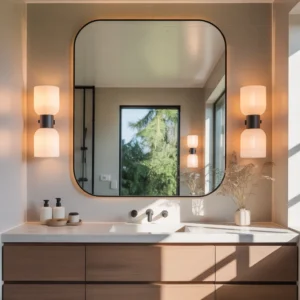
Choosing between a framed and frameless bathroom mirror is less about which option is universally better and more about which one fits your bathroom, vanity, design style, and maintenance preferences. A framed mirror adds definition and decorative character, while a frameless mirror creates a cleaner, more streamlined appearance.
The best choice depends on how you want the mirror to function within the room. This guide compares framed vs. frameless bathroom mirrors by appearance, bathroom size, maintenance, durability, installation, and design style so you can choose with confidence.
Table of Contents
Framed vs. Frameless Bathroom Mirror: What’s the Difference?
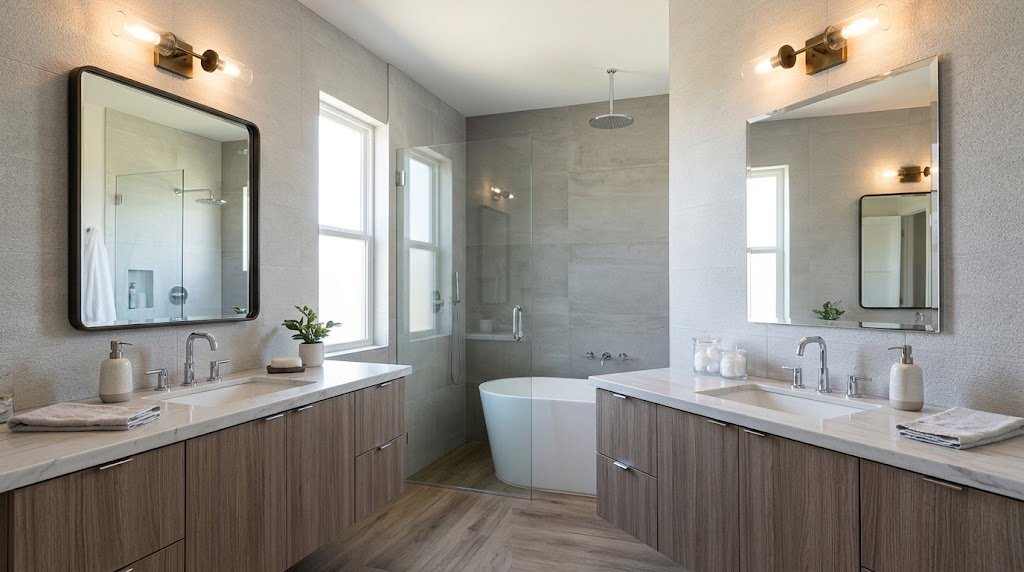
The primary difference is simple: a framed bathroom mirror has a visible border surrounding the mirror glass, while a frameless bathroom mirror has exposed finished edges without a separate decorative frame.
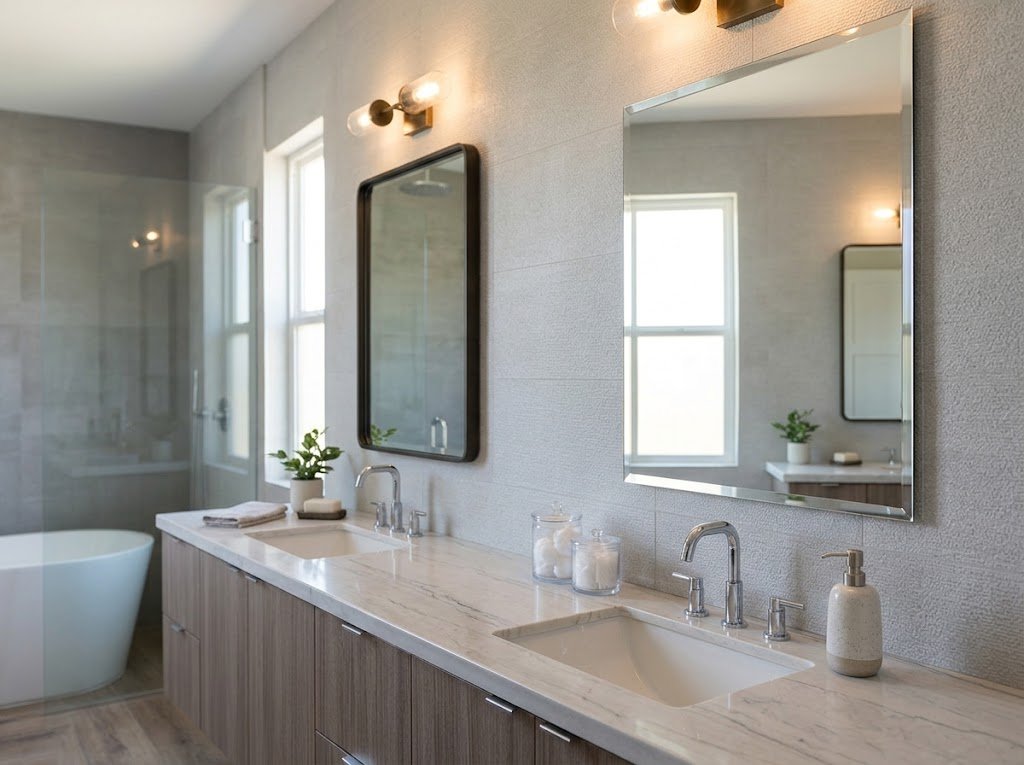
That structural difference affects more than appearance. It can change how substantial the mirror looks on the wall, how it coordinates with the vanity and fixtures, and how much attention the mirror receives within the overall bathroom design.
What Is a Framed Bathroom Mirror?
A framed bathroom mirror consists of reflective glass surrounded by a separate frame. The frame can be made from materials such as wood, metal, plastic, composite material, or other moisture-appropriate finishes.
Because the frame becomes part of the mirror’s visual design, framed mirrors offer considerable flexibility. A slim metal frame can complement a contemporary bathroom, while a substantial wood-look or decorative frame can add warmth to a traditional or transitional space.
Framed mirrors work particularly well when you want the mirror to function as a design feature rather than simply as a reflective surface. The frame can coordinate with vanity hardware, faucets, lighting finishes, cabinetry, or other architectural details.
The important consideration is the environment. A bathroom exposes materials to humidity, splashes, and temperature changes, so the frame’s construction and finish matter. A frame that is appropriate for a dry interior space is not necessarily the best choice for repeated bathroom moisture.
What Is a Frameless Bathroom Mirror?
A frameless bathroom mirror is a mirror without a separate decorative border around the glass. The finished mirror edges remain visible, giving the installation a simple and uninterrupted appearance.
This design is especially common in contemporary and minimalist bathrooms because it places less visual emphasis on the mirror’s border. Instead, the glass blends more quietly with the wall and surrounding fixtures.
Frameless mirrors can be installed using appropriate mounting hardware, clips, brackets, or other methods suitable for the mirror and wall. Some installations may use specialized adhesive systems, but the correct method depends on the mirror’s size, weight, construction, wall surface, and manufacturer instructions.
Because there is no decorative frame, the quality of the glass, edge finishing, and installation becomes particularly important.
Framed vs. Frameless Bathroom Mirror Compared
Neither style is automatically superior. A framed mirror generally offers more decorative presence, while a frameless mirror emphasizes simplicity and visual continuity.
| Feature | Framed Mirror | Frameless Mirror |
|---|---|---|
| Appearance | Decorative and defined | Clean and minimalist |
| Style | Traditional, transitional, modern | Modern, contemporary, minimalist |
| Visual weight | Usually more substantial | Usually lighter visually |
| Cleaning | Glass plus frame care | Primarily glass and edges |
| Customization | Many frame materials, colors, and profiles | More dependent on shape, size, and edge treatment |
| Small bathrooms | Can work well with the right frame | Often gives a lighter visual impression |
| Maintenance | Depends on frame material and construction | Fewer decorative surfaces to maintain |
| Best suited to | Decorative or statement-focused designs | Streamlined and understated designs |
The table is a starting point rather than a rulebook. A large frameless mirror can have more visual impact than a small framed mirror, and a slim framed mirror may look just as light as a frameless design.
Framed vs. Frameless Bathroom Mirror: Pros and Cons
Advantages of Framed Bathroom Mirrors
They add decorative character.
The frame creates a defined boundary around the mirror and can become an important part of the bathroom’s visual composition.
They offer more styling options.
Different frame materials, finishes, colors, widths, and profiles make it easier to coordinate the mirror with existing bathroom elements.
They can create a focal point.
A distinctive frame can draw attention to the vanity area and help the mirror feel like a deliberate design choice rather than a purely functional fixture.
They work across several design styles.
Framed mirrors are not limited to traditional bathrooms. A thin black metal frame, for example, can suit a contemporary space, while other frame designs can complement transitional or farmhouse-inspired interiors.
They can coordinate with other finishes.
A frame can visually connect the mirror to cabinet hardware, faucets, lighting, or other finishes without requiring those elements to match exactly.
Disadvantages of Framed Bathroom Mirrors
The frame adds visual weight.
A thick or highly decorative frame can make the mirror feel more prominent and may compete with other strong design elements.
The frame requires additional care.
Cleaning is not limited to the glass. Depending on the material and finish, the frame may need its own cleaning method.
Moisture matters.
Bathroom humidity and water exposure can affect some frame materials or finishes over time. This makes construction and moisture resistance important considerations.
It may not suit an ultra-minimalist design.
If your goal is a very clean wall-to-glass appearance, a visible frame may introduce more visual detail than you want.
Advantages of Frameless Bathroom Mirrors
They create a clean appearance.
Without a separate border, the mirror has a simple visual edge that works naturally with minimalist and contemporary interiors.
They have less visual bulk.
The absence of a frame can make the mirror feel less visually heavy, particularly when the mirror occupies a large portion of the wall.
They are easy to coordinate.
Because there is no frame color or material to match, a frameless mirror can work with a wider range of vanity finishes, hardware, and fixtures.
They emphasize the mirror itself.
A frameless design keeps attention on the reflective surface rather than its surrounding border.
They can work well in streamlined bathrooms.
When the room already has clean cabinetry, simple hardware, and restrained finishes, a frameless mirror can maintain the same design language.
Disadvantages of Frameless Bathroom Mirrors
They offer less built-in decoration.
Without a frame, the mirror itself provides less visual ornamentation, so the surrounding vanity, lighting, tile, or hardware may need to provide the room’s decorative character.
The edges are exposed.
The mirror’s edge treatment becomes an important part of its appearance and installation. Improperly finished or chipped edges may stand out more visibly.
They may feel too plain in some bathrooms.
A highly traditional or decorative bathroom may benefit from the stronger visual definition provided by a frame.
Installation still requires care.
A frameless mirror is not automatically easier to install simply because it has fewer components. Large or heavy mirrors require suitable mounting methods and proper support.
Which Is Better for a Small Bathroom?
For many small bathrooms, a frameless mirror can create a lighter and less visually crowded appearance, but that does not mean every small bathroom should use one.
The key issue is visual proportion. A bathroom with limited wall space can feel busy when several fixtures, finishes, shelves, and decorative elements compete for attention. A simple mirror can help keep the vanity wall visually restrained.
Mirror size matters, too. Choosing the right mirror size helps maximize the available wall space, whether you prefer a framed or frameless design.
A thin framed mirror can still be an excellent choice in a small bathroom when the frame adds useful contrast or coordinates with the vanity and hardware. The goal is not to eliminate every visual detail; it is to avoid a frame that feels disproportionately heavy for the space.
When choosing for a smaller bathroom, consider:
- The mirror’s width relative to the vanity
- Frame thickness, if applicable
- Available wall space
- The number of other visual elements nearby
- Lighting and fixture placement
- Whether the overall room already feels visually busy
In other words, a well-proportioned framed mirror can work in a small bathroom just as a poorly proportioned frameless mirror can fail.
Which Bathroom Mirror Works Best With a Modern Design?
For a modern or minimalist bathroom, a frameless mirror is often the natural choice because its simple edges support a clean, uncluttered design. A framed mirror can still create a contemporary look when its frame design and finish coordinate well with the bathroom’s overall style.
Minimalist bathrooms
Frameless mirrors generally fit minimalist spaces well because they introduce fewer visual elements. They work especially naturally with simple vanities, restrained hardware, and clean architectural lines.
Contemporary bathrooms
Both options can work. A frameless mirror keeps the design understated, while a slim metal frame can add definition without making the mirror appear overly traditional.
Traditional bathrooms
A framed mirror is often the stronger stylistic match because the frame can provide the decorative detail associated with traditional interiors.
Transitional bathrooms
Both styles can work particularly well. A simple framed mirror can bridge traditional and contemporary elements, while a restrained frameless design can keep the room from becoming visually heavy.
Farmhouse-inspired bathrooms
A framed mirror can add warmth and texture, especially when its material and finish coordinate with the vanity or other natural-looking elements. However, a simple frame rather than an overly ornate one is usually easier to integrate into a relaxed farmhouse-inspired design.
What matters most is how well the mirror style complements your bathroom, rather than assuming one option is always better than the other. Consider the entire room rather than choosing the mirror in isolation.
Framed vs. Frameless Bathroom Mirror: Cleaning and Maintenance
Both types require routine glass cleaning, but the surrounding construction changes what else you need to maintain.
Cleaning a Frameless Mirror
A frameless mirror primarily requires attention to the glass and exposed edges.
Use a suitable glass-cleaning approach and avoid allowing excessive moisture to remain around the edges. In a bathroom, water droplets, toothpaste splashes, soap residue, and other everyday contaminants can accumulate around the vanity area.
When cleaning, avoid saturating areas around the mirror’s edges or mounting points. The exact cleaning method should also follow the mirror manufacturer’s instructions, particularly for specialty finishes or treatments.
Cleaning a Framed Mirror
A framed mirror requires care for both the reflective surface and the frame.
The best care approach varies based on the type of material and finish used for the frame. For example, a frame made from a moisture-sensitive material should not be treated the same way as a metal frame designed for bathroom use.
Pay particular attention to areas where water can collect near the lower edge of the frame. Good bathroom ventilation can also help reduce persistent humidity and moisture exposure.
The practical difference is simple: a frameless mirror generally has fewer surfaces to maintain, while a framed mirror adds another material whose cleaning and moisture requirements depend on its construction.
Which Bathroom Mirror Is More Durable?
There is no reliable rule that says framed mirrors are always more durable than frameless mirrors, or vice versa. Durability depends on the quality of the mirror, edge treatment, frame construction, installation, and bathroom environment.
For either style, consider these factors:
Mirror glass quality: The mirror itself should be appropriately manufactured for its intended use.
Edge finish: Because a frameless mirror has no border to cover its perimeter, the quality and finish of its edges are clearly visible and should be carefully considered.
Frame material: With a framed mirror, the quality and moisture suitability of the frame can affect long-term performance.
Moisture exposure: A bathroom with frequent humidity and water exposure places greater demands on surrounding materials and finishes.
Installation quality: A properly supported mirror is less likely to experience problems caused by inappropriate mounting.
Bathroom ventilation: Effective ventilation can help manage moisture and humidity in the room, benefiting the bathroom environment generally.
Rather than focusing only on which mirror may last longer, consider its build quality and whether its materials and construction are appropriate for your bathroom’s moisture and everyday use.
Framed vs. Frameless Bathroom Mirror Installation
Installation requirements vary considerably depending on the mirror’s size, weight, wall material, mounting system, and location.
Installing a Framed Bathroom Mirror
A framed mirror may be heavier than a comparable frameless mirror, although this depends on the particular construction.
Before installation, consider:
- The mirror’s total weight
- Appropriate mounting hardware
- The wall’s construction
- Where wall support is available
- Clearance around the vanity and other fixtures
- The manufacturer’s mounting instructions
A frame does not eliminate the need for proper support. For oversized or heavy mirrors, choose mounting hardware that can safely support the mirror’s weight and is suitable for the type of wall.
Installing a Frameless Bathroom Mirror
Frameless mirrors can use different mounting systems, including suitable clips, brackets, specialized hardware, or adhesive systems designed for the application.
The correct approach depends on the specific mirror and wall. Wall preparation is particularly important because an uneven, unsuitable, or poorly prepared surface can affect how securely the mirror sits.
Edge protection also deserves attention during handling and installation. A frameless mirror’s edges remain exposed, so they should be handled carefully to avoid chips or other damage.
Never assume that a mounting method is appropriate simply because it worked for another mirror. Follow the manufacturer’s installation requirements and use hardware suitable for the mirror’s weight and the wall.
When Should You Hire a Professional?
Professional installation is worth considering when the mirror is unusually large or heavy, the wall surface is difficult to work with, or you are uncertain about the appropriate mounting method.
Professional help can also make sense when the mirror must be positioned around electrical fixtures, lighting, unusual wall conditions, or a complicated vanity arrangement.
For a large mirror, the issue is not simply getting it onto the wall. Safe handling, accurate positioning, adequate support, and protection of the mirror and surrounding finishes all matter.
How to Choose Between a Framed and Frameless Bathroom Mirror
Start with the role you want the mirror to play in the bathroom.
Choose a framed mirror if you want:
- More decorative character
- A stronger visual focal point
- A defined border around the reflective surface
- Coordination with bathroom finishes and hardware
- A traditional or transitional appearance
Choose a frameless mirror if you want:
- A minimalist appearance
- A clean contemporary look
- Less visual emphasis around the mirror
- A simple surface that coordinates easily with different finishes
- A lighter visual effect on the wall
There is also a useful middle ground: a very thin, understated frame can provide definition without the visual weight of a substantial decorative frame.
Think about the mirror together with the vanity rather than separately. The proportions, shape, lighting, cabinet style, hardware, and wall finish all influence whether the final combination feels balanced.
Framed vs. Frameless Bathroom Mirror: Which One Should You Choose?
If you want a simple decision, use the bathroom’s design priorities as your guide.
- Best for minimalist bathrooms: Frameless
- Best for decorative bathrooms: Framed
- Best for traditional styling: Framed
- Best for contemporary styling: Frameless
- Best for a statement piece: Framed
- Best for a simple, clean appearance: Frameless
These are design-oriented recommendations rather than hard rules. A contemporary bathroom can look excellent with a carefully selected framed mirror, and a traditional bathroom can successfully incorporate a simple frameless mirror.
The mirror’s size, proportion, shape, quality, edge treatment, and installation can matter just as much as whether it has a frame.
If you are unsure, look at the vanity wall as a whole. If the room already contains several strong finishes or decorative features, a frameless mirror may provide useful visual restraint. If the wall feels plain and needs definition, a framed mirror can become a purposeful design element.
Key Factors to Check Before Choosing a Bathroom Mirror
Before choosing a mirror, evaluate the actual conditions around your vanity rather than selecting a style based only on appearance.
Vanity width
Consider how the mirror relates to the vanity below it. The mirror should look proportionate to the vanity and leave appropriate space for surrounding fixtures and walls.
Mirror height
Height affects both appearance and usability. Check the available wall space and the location of lighting, cabinets, outlets, and other fixtures before choosing a size.
Available wall space
Measure the wall rather than estimating visually. Account for nearby doors, cabinets, lighting, faucets, and other objects that may affect the usable area.
Bathroom style
Decide whether you want the mirror to blend into the room or act as a decorative focal point. This is one of the clearest distinctions between many frameless and framed designs.
Frame material
If you choose a framed mirror, evaluate the frame’s material and finish for the bathroom environment. Moisture exposure should be part of the decision.
Mirror shape
Rectangular mirrors are common, but rounded, arched, oval, and other shapes can significantly change the character of the vanity area. Shape can sometimes have a greater visual impact than the presence of a frame.
Mounting method
Check how the mirror is designed to be installed before purchasing it. Make sure the mounting system is compatible with the mirror’s weight and your wall.
Moisture exposure
Consider how much steam, splashing, and humidity the mirror will experience. This is particularly important when selecting frame materials and finishes.
Lighting
Make sure the mirror does not interfere with vanity lighting or other fixtures. The mirror and lighting should work together rather than compete for the same wall space.
Cleaning requirements
Think about how much maintenance you are comfortable with. A framed mirror may require care for both glass and frame, while a frameless mirror generally has fewer surrounding surfaces.
Budget
Compare the complete installation rather than looking only at the mirror’s purchase price. The mirror, mounting hardware, installation requirements, and any associated modifications can all affect the overall cost.
Safety and installation requirements
For large or heavy mirrors, make sure the mounting system and installation method are appropriate. When the installation is complex or you are unsure about the wall or mounting requirements, professional assistance can be the safer choice.
When choosing between a framed and frameless design, consider more than appearance. Factors such as mirror size, vanity width, bathroom style, mounting requirements, and available wall space can all affect the right choice. For a broader overview of mirror styles, shapes, placement, and selection tips, see our Ultimate Guide to Bathroom Mirrors.
FAQs
Is a framed or frameless mirror better for a bathroom?
Neither is universally better. A frameless bathroom mirror is often a strong choice for minimalist and contemporary spaces, while a framed mirror can be better when you want decorative character, stronger visual definition, or a traditional or transitional look.
Are frameless bathroom mirrors outdated?
No. Frameless mirrors remain a practical design choice because their simple appearance works with contemporary, minimalist, and many transitional bathroom designs. Their suitability depends more on the overall bathroom style than on whether the mirror has a frame.
Are framed bathroom mirrors still popular?
Yes. Framed mirrors continue to be useful for bathrooms where the mirror is intended to contribute decorative detail or coordinate with other finishes. The frame style can make a framed mirror feel traditional, transitional, contemporary, or otherwise appropriate to the room.
Do frameless mirrors make a bathroom look bigger?
A frameless mirror can make a bathroom feel visually lighter because it has fewer visual boundaries around the glass. However, it does not physically increase the room’s size. The mirror’s size, placement, lighting, and relationship to the rest of the bathroom also influence the perceived spaciousness of the room.
Are framed mirrors harder to clean?
They can require more cleaning attention because you need to maintain both the glass and the frame. How much additional maintenance is required depends on the frame material, finish, and bathroom conditions.
Can a frameless mirror work with a traditional bathroom?
Yes. A frameless mirror can work in a traditional bathroom when its shape, size, lighting, vanity, and surrounding finishes create a balanced design. However, a framed mirror may provide more decorative definition if the traditional room relies heavily on ornamental details.
Should a bathroom mirror be framed?
A bathroom mirror does not have to be framed. Choose a frame when you want additional decorative character or a defined visual border; choose frameless when you prefer a simpler, more streamlined appearance. The best choice depends on the bathroom’s style, proportions, maintenance requirements, and installation conditions.
Conclusion
The choice between a framed vs. frameless bathroom mirror ultimately comes down to the look and function you want from your vanity area.
A framed mirror is a strong option when you want decorative character, a defined focal point, or a mirror that coordinates with traditional and transitional finishes. A frameless mirror is often better suited to minimalist and contemporary bathrooms where a clean, understated appearance is the priority.
Before deciding, look beyond the frame itself. Consider the mirror’s size, shape, proportions, construction, edge treatment, moisture exposure, cleaning requirements, mounting method, and relationship to the vanity and lighting.
The best bathroom mirror is not necessarily the one that is more popular. It is the one that fits your bathroom’s design, available space, maintenance preferences, and installation requirements.