Introduction
Choosing between LED vs regular bathroom mirrors comes down to more than appearance. An LED bathroom mirror has built-in lighting that can improve visibility around your face, create a modern look, and reduce the need for some separate light fixtures. A regular bathroom mirror reflects light from existing fixtures, offering a simple, versatile, and often more affordable option.
The better choice depends on your bathroom’s current lighting, how you use your mirror, your budget, and the features you actually need. If you frequently apply makeup, shave, or get ready in a dim bathroom, an LED mirror may be worth considering. If you already have effective vanity lighting and want a straightforward mirror, a regular model may provide better value.
This guide compares both options, including lighting quality, energy use, installation costs, anti-fog features, maintenance, and design, so you can choose the right mirror for your space.
Table of Contents
LED vs Regular Bathroom Mirrors: What Is the Difference?
The main difference is that an LED bathroom mirror has integrated lighting, while a regular bathroom mirror relies on light from separate fixtures or other sources. This affects how each mirror illuminates your face, how it is installed, and how much it may cost to purchase and maintain.
What Is an LED Bathroom Mirror?
An LED bathroom mirror incorporates light-emitting diodes into its design. The lights may shine forward through or around the mirror’s reflective surface, or backward toward the wall to create a soft glow.
LED bathroom mirrors can come with different built-in features, such as:
- Adjustable brightness for different grooming tasks.
- Selectable color temperatures, such as warm, neutral, or cool white.
- Touch-sensitive controls or a conventional switch.
- An integrated defogging pad.
- A built-in clock or other optional features.
Not every LED mirror includes all these functions. Some models provide basic illumination, while others combine lighting with several convenience features.
An LED mirror can be particularly useful when the lighting around your vanity is insufficient or when you want a streamlined appearance without adding separate fixtures.
What Is a Regular Bathroom Mirror?
A regular bathroom mirror is a reflective glass panel, usually with a backing or frame, that does not have integrated lighting. It relies on natural daylight, ceiling lights, wall sconces, or dedicated vanity lights to illuminate the person standing in front of it.
Regular mirrors come in many shapes, sizes, and styles, including framed, frameless, round, rectangular, and medicine cabinet designs.
Their main advantage is flexibility. You can choose a mirror that suits your bathroom and pair it with lighting that meets your needs. If the lighting needs to be changed later, you may be able to update the fixtures without replacing the mirror.
A regular mirror is not necessarily inferior for grooming. When paired with well-positioned, high-quality vanity lighting, it can provide excellent visibility without built-in LEDs.
How Do They Differ in Everyday Use?
An LED mirror provides light directly from the mirror itself, while a regular mirror reflects light from elsewhere in the room. That distinction can change how clearly you see your face during everyday grooming.
For example, a backlit LED mirror may create an attractive ambient glow but provide limited illumination directly onto your face. A front-lit model may offer more useful task lighting, depending on its design and brightness.
A regular mirror paired with vertical lights on either side can distribute light across your face effectively and reduce distracting shadows.
In practical terms, the choice is not simply between a modern mirror and an outdated one. It is between integrated lighting and a separate lighting arrangement. The quality and placement of the light matter just as much as the mirror itself.
LED vs Regular Bathroom Mirrors: Side-by-Side Comparison
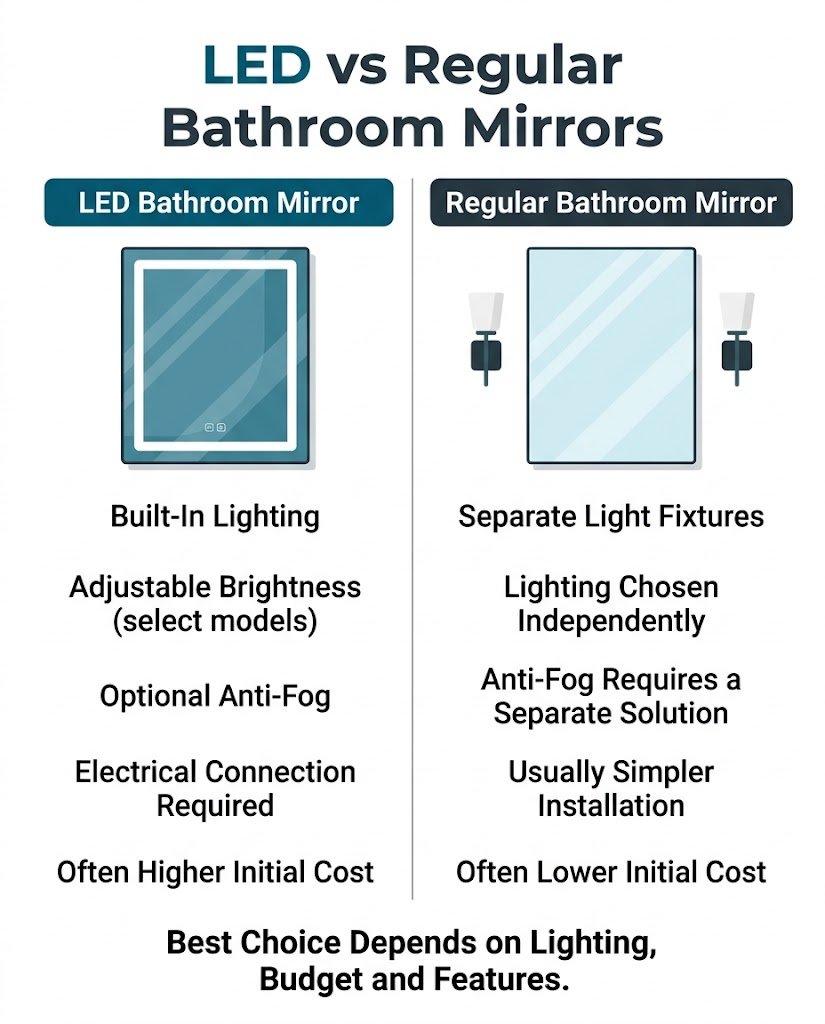
The table below summarizes the main differences between LED and regular bathroom mirrors. Actual performance and cost depend on the mirror’s construction, lighting arrangement, features, and installation requirements.
| Feature | LED bathroom mirror | Regular bathroom mirror |
|---|---|---|
| Built-in lighting | Yes | No |
| Grooming visibility | Depends on light placement and brightness | Depends on separate lighting |
| Energy use | Uses electricity for integrated LEDs | Mirror itself uses no electricity |
| Initial cost | Often higher | Often lower |
| Installation | May require electrical connections | Usually simpler |
| Anti-fog function | Available on selected models | Requires a separate solution |
| Maintenance | Glass cleaning plus possible electrical servicing | Primarily glass and frame care |
| Design | Often sleek and contemporary | Available in traditional and modern styles |
| Customization | May offer dimming and color settings | Lighting can be selected separately |
| Long-term flexibility | Replacement may involve integrated electronics | Mirror and lighting can often be updated independently |
The key takeaway: An LED mirror combines two functions in one fixture, but a regular mirror offers greater freedom to select and replace the lighting separately. Neither option automatically delivers better results; the complete setup matters.
Key Differences Between LED and Regular Bathroom Mirrors
Lighting Quality and Visibility
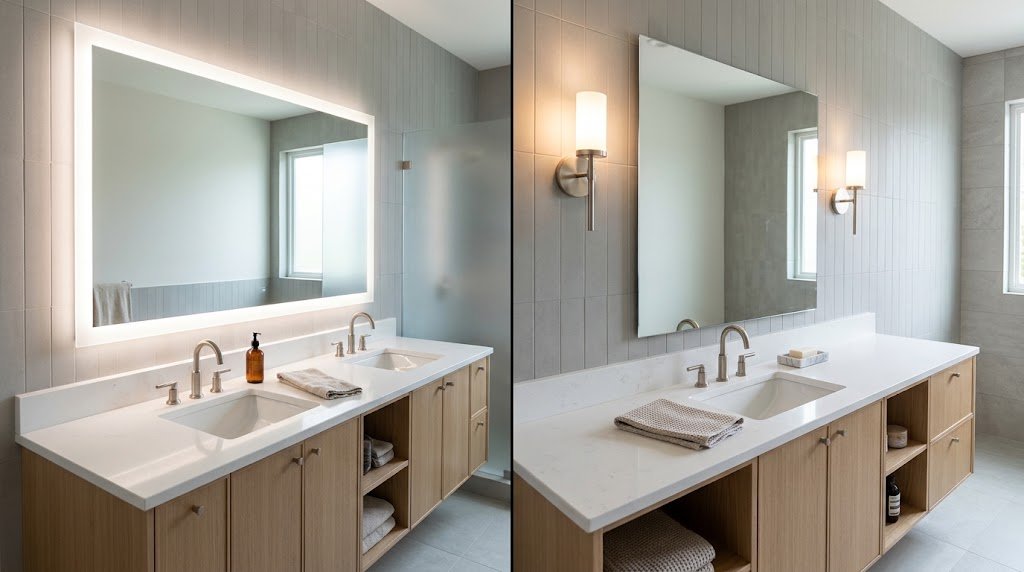
Lighting quality is one of the most important factors when comparing these mirrors. The goal is not simply to make the bathroom brighter; it is to illuminate your face evenly enough for comfortable, accurate grooming.
An LED mirror can help by placing the light near the face rather than relying entirely on a ceiling fixture. However, the result depends on whether the light shines forward or mainly behind the mirror.
- Front-lit LED mirrors: Direct light toward the user and can provide useful illumination for shaving, skincare, and makeup.
- Backlit LED mirrors: Direct light toward the wall, creating a decorative glow. They may contribute less to facial illumination.
- Regular mirrors with side lighting: Can provide excellent visibility when wall sconces or other suitable fixtures illuminate both sides of the face.
- Regular mirrors with overhead lighting: May work well, but a single poorly positioned fixture can create shadows around the eyes, nose, and chin.
For the best results, assess the light falling on your face rather than judging the mirror by its appearance alone. If possible, choose lighting with good color rendering so skin tones and makeup shades appear natural.
Makeup, Shaving, and Everyday Grooming
For detailed grooming, the better mirror is the one that provides consistent, well-distributed light.
An LED bathroom mirror can be a convenient choice for applying makeup, trimming facial hair, shaving, and performing skincare routines, especially if the existing vanity lighting is weak. Dimmable models also let you adjust brightness for different tasks and times of day.
However, an LED mirror is not automatically the best option for makeup. A dim backlit model may create a pleasant atmosphere without illuminating the face sufficiently. Color temperature and color rendering also influence how accurately you see skin tones and cosmetic colors.
A regular mirror can work just as well when paired with suitable vanity lighting. For example, a rectangular mirror between two vertical wall lights can provide balanced illumination without requiring integrated LEDs.
Practical tip: If grooming is your main priority, compare the mirror’s light output, distribution, and color quality before considering decorative features.
Energy Consumption and Electricity Costs
An LED bathroom mirror uses electricity to operate its integrated lighting. A regular mirror uses no electricity by itself, although the separate lights illuminating it do.
LED technology is generally energy-efficient compared with traditional incandescent lighting. ENERGY STAR explains that LED lighting products can produce light using substantially less energy than incandescent alternatives. However, that does not mean every LED mirror consumes less electricity than every regular-mirror setup. The total depends on the wattage of the integrated LEDs, the power used by separate fixtures, and how long each system operates.
To estimate the energy used by an LED mirror, use this formula:
Energy consumed (kWh) = Power (watts) × Hours used ÷ 1,000
For example, a hypothetical 30-watt LED mirror used for two hours daily consumes:
30 × 2 ÷ 1,000 = 0.06 kWh per day.
Over 30 days, that equals 1.8 kWh. Multiply this figure by your electricity rate to estimate the lighting cost. This example excludes any separate defogger or other powered features.
When comparing systems, calculate the combined consumption of the LED mirror and any additional lighting it needs versus the regular mirror’s separate lights.
Upfront Price and Installation Costs
A regular mirror is often less expensive to purchase because it does not include integrated lighting or electronic features. Basic framed and frameless mirrors are widely available across different sizes and price points.
An LED mirror may cost more because it combines reflective glass, lighting components, wiring, controls, and optional features in one product. More advanced models may also include dimming, selectable color temperatures, or a defogging pad.
Installation can change the total cost significantly.
With a regular mirror, the main expenses are generally the mirror, mounting hardware, and any separate light fixtures you choose to install. An LED mirror may need an appropriate electrical connection, and some models are designed for hardwiring rather than plug-in use.
If you already have good vanity lighting, a regular mirror may be the more economical choice. If you need both a mirror and new grooming lights, compare the total cost of both complete setups rather than comparing the mirror prices alone.
Anti-Fog Features and Condensation
An LED mirror does not automatically prevent fogging. Anti-fog performance depends on whether the model includes a dedicated defogging feature, such as a heating pad behind the glass.
Bathroom mirrors fog when moisture in warm air condenses on a cooler surface. A powered defogger warms the designated area of the mirror to help prevent that condensation from forming.
Consider these differences:
- LED mirror without a defogger: Provides lighting but may still fog after a hot shower.
- LED mirror with a defogger: Can keep the treated portion clearer when the feature is used as directed.
- Regular mirror: Can fog under the same conditions, although ventilation and room conditions affect how quickly it clears.
Check the product specifications carefully. A listing that advertises LED lighting does not necessarily include anti-fog technology, and the defogging feature may cover only part of the glass.
If condensation is a frequent problem, also consider bathroom ventilation. A mirror defogger helps with visibility, but it does not remove moisture from the room.
Durability, Maintenance, and Lifespan
Both mirror types can last for many years when properly manufactured, installed, and maintained. Their long-term reliability depends on the quality of the glass, backing, frame, mounting hardware, environmental conditions, and care.
A regular mirror has relatively few components. Routine maintenance usually involves cleaning the glass, checking the frame and mounting hardware, and addressing any deterioration around the edges.
An LED mirror adds electrical components that may eventually require attention. The LEDs can gradually lose brightness, and drivers, sensors, switches, or defogging components may fail. A fault in one component does not necessarily mean the glass itself needs replacing, but repairability varies by model.
LED lighting can have a long useful life, although the lifespan advertised for the LEDs does not guarantee that the entire mirror or its electronics will last equally long. The U.S. Department of Energy explains that LED performance can decline gradually and that electronic components may fail before the LEDs themselves.
To protect either mirror:
- Use cleaning products suitable for the glass and its finish.
- Avoid abrasive pads that can scratch surfaces or damage coatings.
- Keep water from accumulating around edges and electrical connections.
- Clean and maintain the mirror according to the care guidelines provided by the manufacturer.
- Check whether replacement parts and warranty support are available before purchasing an LED model.
Appearance and Design Flexibility
LED mirrors are popular in contemporary bathrooms because their integrated lighting can create a clean, streamlined appearance. Backlit models often produce a floating effect, while front-lit designs combine illumination with the reflective surface.
Many models have simple rectangular or circular shapes that work well in modern interiors. Dimming and color settings may also let you adjust the atmosphere without changing the main lighting fixtures.
Regular mirrors offer a broader range of decorative possibilities. Options include ornate frames, natural wood finishes, metal borders, frameless panels, vintage styles, and mirrored medicine cabinets.
They also provide greater flexibility if you like changing your bathroom’s appearance. You can replace a wall sconce or mirror independently without necessarily upgrading both.
Choose an LED mirror if integrated lighting supports your preferred design. Choose a regular mirror if frame style, flexibility, or compatibility with existing fixtures matters more.
Pros and Cons of LED Bathroom Mirrors
LED mirrors combine reflective glass and built-in lighting, making them convenient for bathrooms where vanity illumination needs improvement. Their disadvantages mainly involve electrical requirements, additional components, and the possibility of paying for features you do not need.
Advantages of LED Mirrors
- Integrated lighting: The mirror provides its own illumination, reducing reliance on separate vanity lights.
- Convenient grooming: Well-designed front-lit models can make shaving, makeup, and skincare easier.
- Contemporary appearance: Backlighting and minimal frames can complement modern bathroom designs.
- Adjustable settings: Selected models allow users to change brightness or color temperature.
- Optional defogging: Models with a dedicated heating pad can help maintain a clear viewing area after showers.
- Potential space savings: Combining a mirror and light source may reduce the number of separate fixtures needed on the wall.
- Efficient lighting technology: LEDs generally use less electricity than comparable incandescent lighting, although actual system consumption depends on the products being compared.
Disadvantages of LED Mirrors
- Higher purchase price: Integrated lighting and additional features can increase the initial cost.
- Electrical requirements: Depending on the model, installation may require a suitable outlet or hardwired connection.
- Potential repair costs: Integrated electronics may be more complicated to repair than a conventional mirror.
- Variable lighting performance: Some designs prioritize decorative backlighting rather than useful facial illumination.
- Features vary by model: Anti-fog, dimming, and adjustable color temperature are not universal.
- Replacement considerations: If integrated components fail, the availability and cost of replacement parts may influence whether repair is worthwhile.
An LED mirror makes the most sense when its lighting or convenience features solve a real problem in your bathroom. Paying extra for functions you rarely use offers little practical benefit.
Pros and Cons of Regular Bathroom Mirrors
Regular bathroom mirrors remain a practical choice because they are simple, widely available, and compatible with many lighting arrangements. Their biggest limitation is that the mirror itself does not provide illumination.
Advantages of Regular Mirrors
- Lower initial cost: Basic models can be economical, particularly when suitable vanity lighting is already installed.
- Simple construction: There are no integrated LEDs, drivers, or electronic controls to maintain.
- Flexible styling: Frames, shapes, finishes, and sizes suit traditional, contemporary, and transitional bathrooms.
- Independent lighting upgrades: You can change the mirror or light fixtures separately.
- Straightforward replacement: Replacing a conventional mirror may be simpler when no electrical components are involved.
- Broad availability: Options range from inexpensive frameless mirrors to decorative statement pieces and mirrored cabinets.
Disadvantages of Regular Mirrors
- Dependence on external lighting: Poorly positioned fixtures can make grooming difficult.
- Potential additional expenses: If your bathroom lacks suitable vanity lights, purchasing and installing them adds to the total cost.
- Separate fixture requirements: A well-lit setup may need wall sconces, a vanity light bar, or another suitable light source.
- Fogging: A conventional mirror may fog after a hot shower unless room conditions or a separate anti-fog solution help prevent it.
- Less integrated appearance: Separate fixtures can require more wall space and may not deliver the seamless look of an LED mirror.
A regular mirror is not a compromise when the surrounding lighting is already well designed. In many bathrooms, it is the simplest way to achieve excellent visibility and the appearance you want.
Is an LED Bathroom Mirror Worth the Extra Cost?
An LED bathroom mirror is worth the extra cost when its integrated lighting, controls, or optional features improve your daily routine enough to justify the price. It may be less worthwhile if you already have effective vanity lighting and need only a reflective surface.
To make the decision, consider the total installation cost, how frequently you use the mirror, and whether its features solve an actual problem.
When an LED Mirror Is Worth Buying
An LED mirror is a strong option when your bathroom has inadequate grooming light or you want to combine the mirror and lighting into one fixture.
It may be worth considering if:
- You struggle to see your face clearly under existing overhead lights.
- You regularly apply makeup, shave, or perform detailed skincare.
- You want adjustable brightness or selectable color temperature.
- You prefer an integrated, contemporary design.
- You frequently use the mirror after showering and want a model with a dedicated defogger.
- You are renovating your bathroom and can plan the mirror’s electrical requirements before installation.
The value is greatest when the selected model provides useful lighting and features that would otherwise require separate purchases.
When a Regular Mirror Offers Better Value
A regular mirror is usually the better value when you already have adequate lighting and do not need integrated features.
Consider a conventional mirror if:
- Your existing vanity lights illuminate your face evenly.
- You want to keep the initial purchase cost low.
- You prefer a decorative frame or a specific traditional style.
- You want to replace the mirror without changing its electrical setup.
- You are furnishing a guest bathroom or powder room used mainly for quick checks.
- You prefer simple products with fewer electronic components.
For example, if your bathroom already has two well-positioned wall sconces beside the mirror, an LED model may offer little improvement in grooming visibility. Spending the additional money on a better-sized mirror or another bathroom upgrade could make more sense.
Should You Upgrade If You Already Have Vanity Lighting?
Not necessarily. If your existing vanity lighting provides even, comfortable illumination, replacing a regular mirror with an LED model may be an aesthetic choice rather than a functional necessity.
First, assess your current setup:
- Check for shadows. Look for dark areas around your eyes, nose, and chin when standing at the vanity.
- Evaluate color quality. Make sure your lighting renders skin tones and makeup colors naturally.
- Consider the light direction. A single overhead fixture may produce more shadows than well-positioned lights beside the mirror.
- Identify the actual problem. If the mirror fogs frequently, better ventilation or a dedicated defogger may help more than integrated LEDs.
- Compare total costs. Include the mirror, any necessary lighting, electrical work, and optional features.
If the current setup works well, keep it. If it does not, compare an LED mirror with the cost of improving your existing vanity lighting before deciding.
Which Bathroom Mirror Is Best for Your Needs?
The best bathroom mirror depends on how you use the space, how much light is available, and which features matter most. An LED mirror is often convenient for integrated grooming illumination, while a regular mirror offers more flexibility and may be more economical.
Best for Makeup and Detailed Grooming
For makeup, shaving, and skincare, choose a mirror with even front-facing illumination and good color rendering.
A front-lit LED mirror is a convenient option when its light reaches your face effectively. Selectable color temperature can also be useful if you want to see how makeup appears under different lighting conditions.
A regular mirror with suitable lighting on both sides can perform equally well. The important consideration is the quality and distribution of the light, not whether the LEDs are built into the glass.
Best for Small Bathrooms
An LED mirror can work well in a small bathroom because it combines two functions in one fixture. A slim, backlit design may also create a sense of visual openness without adding a bulky frame.
However, a regular frameless mirror paired with a compact wall light can achieve a similarly uncluttered look.
Measure the available wall space, including clearance around faucets, cabinets, and light fixtures. Also consider whether a mirrored medicine cabinet would provide useful storage without making the vanity area feel crowded.
Best choice: An LED mirror if you need integrated lighting and want to minimize separate fixtures; a regular mirror if a compact, well-lit setup already meets your needs.
Best for Budget-Conscious Homeowners
A regular bathroom mirror is generally the most economical choice when you already have suitable lighting.
Basic mirrors offer a wide selection of sizes and finishes without the additional cost of integrated electronics. If new lighting is required, however, include the cost of the fixtures and installation when comparing alternatives.
An LED mirror can sometimes be competitive when you need both a mirror and vanity lighting. The only reliable way to compare value is to evaluate complete setups with similar dimensions and lighting performance.
Best for Modern Bathroom Designs
An LED bathroom mirror is a natural fit for many contemporary interiors. Backlighting creates a soft halo, while front-lit designs provide a functional lighting feature without requiring a separate light bar.
A regular mirror can look equally modern when paired with minimalist framing, clean lines, and carefully selected wall lights.
Choose the style that complements the vanity, faucet finish, cabinetry, and overall bathroom design. A mirror should feel like part of the room rather than an isolated feature.
Best for Bathrooms With Good Existing Lighting
A regular mirror is often the better choice when your bathroom already has balanced vanity lighting and adequate ambient illumination.
In this situation, integrated LEDs may add convenience or visual appeal, but they may not meaningfully improve your daily routine.
Before spending more, consider whether you would benefit more from a different mirror size, a storage cabinet, or a design that better suits the vanity.
What to Check Before Buying an LED Bathroom Mirror
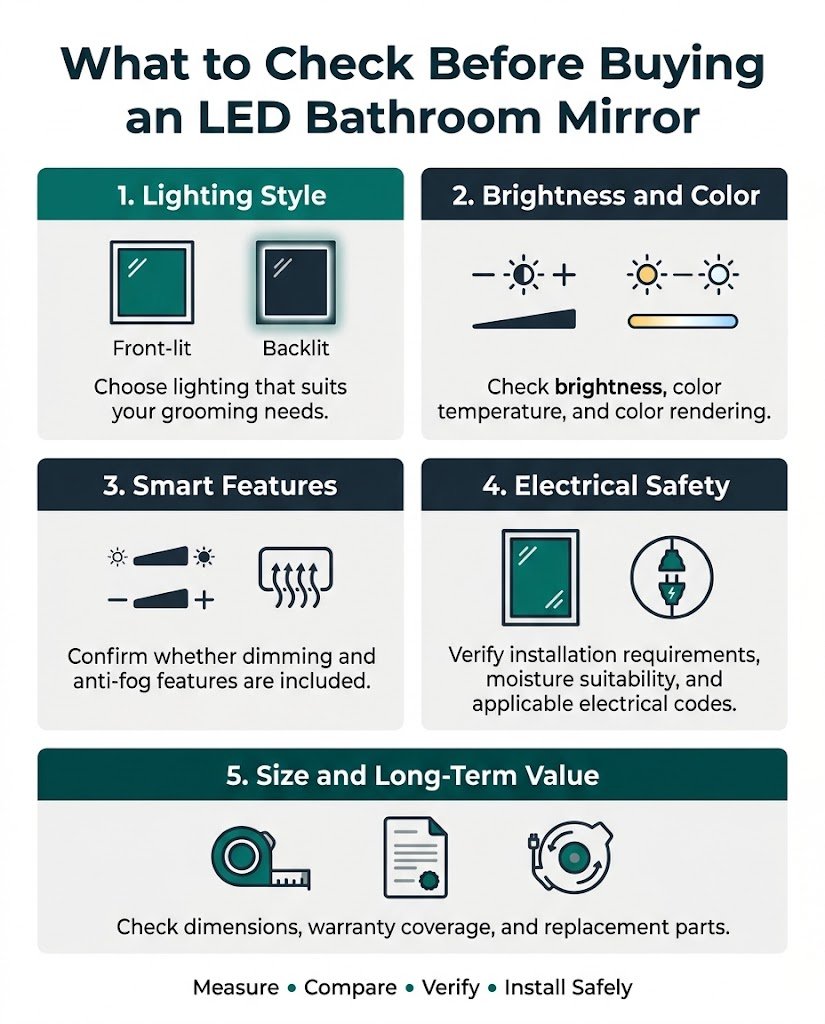
Before buying an LED mirror, look beyond its appearance and advertised features. Confirm that the light is suitable for grooming, the mirror fits your vanity, the electrical connection is appropriate, and the manufacturer provides clear warranty and maintenance information.
Front-lit LED mirror
Light shines forward from the mirror’s illuminated surface or perimeter. Depending on the design, this can provide useful illumination for grooming and reduce shadows.
Backlit LED mirror
Light shines toward the wall behind the mirror, creating a decorative halo. It is useful for ambiance but may not provide enough direct light for detailed tasks.
Some mirrors combine front and backlighting. This can provide both task illumination and a decorative effect, although performance still depends on the design.
If grooming is your priority, do not assume a bright-looking halo means the mirror will adequately illuminate your face.
Brightness and Color Temperature
Brightness and color temperature affect how comfortable and useful an LED mirror is.
Brightness describes how much light the fixture produces. A mirror that looks attractive in a dim showroom may not provide sufficient illumination for detailed grooming. Check the manufacturer’s light-output specifications, ideally including lumens, and consider the room’s other light sources.
Color temperature indicates whether a light source gives off a warm, yellowish glow or a cooler, bluish-white appearance. It is measured in kelvins (K).
- Warm white creates a softer, more relaxed appearance.
- Neutral white can provide a balanced look for everyday grooming.
- Cool white creates a crisper appearance, although very cool lighting may not suit every bathroom or user.
A selectable color-temperature feature can offer flexibility, but it is not essential if a fixed setting already meets your needs.
Also check the color rendering index (CRI), which indicates how accurately a light source reveals colors compared with a reference source. Better color rendering is particularly useful for makeup and other tasks where color accuracy matters.
Dimming and Anti-Fog Functions
Dimming allows you to adjust the light to suit different situations. Brighter illumination can help with detailed grooming, while a lower setting may be more comfortable for a nighttime visit to the bathroom.
A dimmer is most useful when it provides a practical range of brightness and is easy to operate. Check whether the dimming function is built in and whether it is compatible with the mirror’s specified controls.
Anti-fog functionality is a separate consideration. If you frequently use the mirror immediately after a hot shower, look for a model that explicitly identifies a heated defogging feature.
Before purchasing, confirm:
- Whether the mirror includes a defogger.
- Which portion of the glass it clears.
- Whether the defogger operates independently of the lights.
- How it is activated and whether it has an automatic shutoff.
- Whether replacement or servicing is available.
Do not pay extra for these features simply because they are advertised as premium. Choose them when they solve a problem you experience regularly.
Electrical Requirements and Bathroom Safety
LED mirrors contain electrical components, so installation must suit the product and the bathroom’s conditions.
Before buying, check whether the mirror is plug-in or hardwired, what voltage and electrical connections it requires, and whether the manufacturer specifies restrictions for installation near showers, tubs, or other wet areas.
Important precautions include:
- Follow the manufacturer’s installation instructions and applicable local electrical codes.
- Use a qualified electrician for hardwiring or any work that requires changes to household wiring.
- Verify that the mirror is rated for its intended bathroom location and exposure to moisture.
- Keep electrical connections protected from water and moisture as specified by the manufacturer.
- Ensure required ground-fault circuit interrupter (GFCI) protection is in place for applicable bathroom receptacles and circuits.
GFCI protection helps reduce the risk of electric shock by interrupting power when it detects a ground fault. It does not make an electrical product safe to use in damp or wet areas if it is not designed for those conditions. The U.S. Consumer Product Safety Commission provides guidance on GFCI protection in bathrooms and other potentially damp areas.
Mirror Size, Warranty, and Replacement Parts
The right size and dependable product support matter as much as the lighting.
Measure the vanity width, the available wall height, and the clearance around faucets, cabinets, and existing fixtures. The mirror should fit the space without obstructing storage doors or creating awkward gaps.
Before ordering, check the following:
- Dimensions: Confirm the actual glass and overall fixture dimensions.
- Lighting specifications: Review brightness, color temperature, and available controls.
- Power connection: Check whether the mirror connects through a standard plug or requires permanent hardwired installation.
- Moisture suitability: Check the manufacturer’s instructions and any relevant product rating.
- Warranty: Understand what is covered, including the LEDs, driver, controls, and defogger if fitted.
- Replacement components: Check whether individual parts can be repaired or replaced without replacing the entire mirror.
- Installation requirements: Determine whether professional installation is recommended or required.
- Return policy: Confirm how damage, defects, and unsuitable dimensions are handled.
A slightly more expensive mirror with clear specifications, a suitable warranty, and accessible replacement parts may offer better long-term value than a cheaper model with limited product support.
FAQs
Are LED bathroom mirrors a better choice than traditional mirrors?
LED bathroom mirrors can be a practical choice if you prefer built-in illumination, brightness adjustment, and a clean, modern appearance. However, a traditional mirror can work just as well for everyday grooming when combined with suitable vanity lights. It may also be a more budget-friendly option. Your ideal choice depends on your lighting preferences, available budget, and bathroom style.
Do LED bathroom mirrors consume much electricity?
LED bathroom mirrors generally use relatively little electricity, but consumption varies by model and operating time. Check the mirror’s wattage and calculate its energy use by multiplying watts by hours of use and dividing by 1,000. If the mirror includes a defogger or other powered features, account for those separately when estimating operating costs.
Can an LED bathroom mirror serve as a replacement for traditional vanity lights?
An LED mirror can replace a separate vanity light in some bathrooms if its output, distribution, and installation meet the room’s lighting needs. However, a backlit mirror may provide mostly decorative illumination and may not adequately light your face. Assess the manufacturer’s specifications and the overall lighting in the bathroom before removing existing fixtures.
Do LED bathroom mirrors prevent fogging?
LED mirrors do not always come with an anti-fog function. These are two different features, and a mirror must have a built-in defogger—typically a heating pad behind the glass—to help prevent condensation on the covered area. Before purchasing, review the product details to make sure an anti-fog system is included.
How long do LED bathroom mirrors last?
There is no single lifespan that applies to every LED bathroom mirror. The useful life depends on LED quality, heat management, operating conditions, and the reliability of electronic components. The LEDs may continue working for a long time, but drivers, controls, or defogging systems can fail earlier. Check the manufacturer’s rated life and warranty rather than relying on a general estimate.
Are regular bathroom mirrors easier to install?
Regular bathroom mirrors are generally simpler to install because they do not have integrated electrical components.Many mirrors can be installed with appropriate mounting hardware, as long as the wall can safely support the mirror’s weight. LED mirrors may require electrical connections or additional mounting considerations, so follow the manufacturer’s instructions and use a qualified electrician when necessary.
Can an LED mirror be installed in every type of bathroom?
No. An LED mirror must be suitable for the intended installation location and connected according to its electrical requirements. Bathrooms contain areas with different levels of exposure to water and moisture, so check the manufacturer’s location restrictions, product ratings, and applicable local codes. A product intended for one bathroom location may not be appropriate for installation near a shower or bathtub.
Final Verdict: LED or Regular Bathroom Mirror?
When comparing LED vs regular bathroom mirrors, the right choice depends on whether you need better integrated lighting or simply a reliable mirror that works with your existing fixtures.
Choose an LED bathroom mirror if you want built-in grooming illumination, a contemporary appearance, or convenient features such as dimming and optional anti-fog technology. It is particularly useful when your current vanity lighting does not provide adequate visibility.
Choose a standard bathroom mirror if your existing lighting provides enough illumination, you’re looking to keep initial costs low, or you want the flexibility to choose your mirror and lighting fixtures independently.
Before buying, compare the complete setup rather than the mirror alone. Consider lighting quality, energy use, installation requirements, maintenance, and the availability of replacement parts. If grooming is your priority, focus on how effectively the light illuminates your face. If appearance and affordability matter more, a well-chosen regular mirror may be all you need.
There is no universal winner. The best bathroom mirror is the one that fits your space, supports your daily routine, and provides the right balance of functionality, appearance, and long-term value.
For detailed review on bathroom mirrors, see our complete guide to bathroom mirror and for types of bathroom mirror, see our guide to bathroom mirror types.